
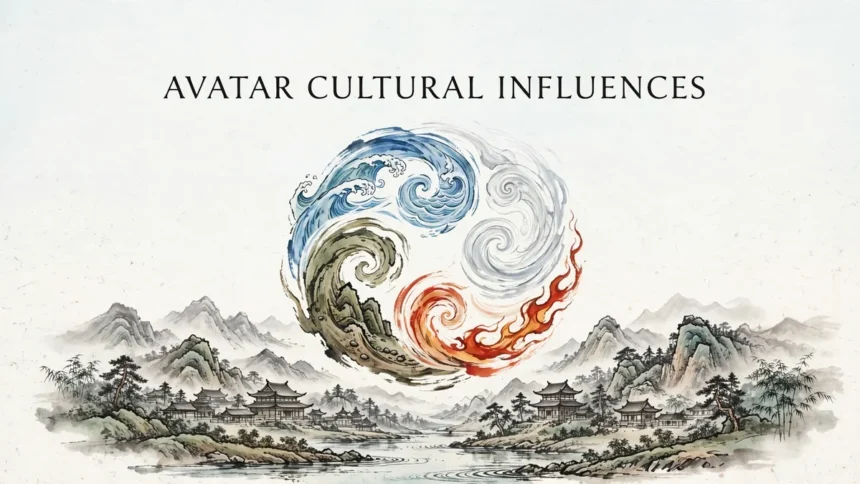
Part of why Avatar: The Last Airbender still feels so lived-in, twenty years after its 2005 premiere, is that its world was never invented from nothing. Creators Michael Dante DiMartino and Bryan Konietzko built the four nations from real Asian and Indigenous cultures — clothing, architecture, food, philosophy, and fighting styles — then blended them into something new. No nation maps neatly onto one real country. Each is a remix, and knowing the ingredients makes rewatching the show richer. Katara’s Water Tribe heritage, for example, is inseparable from the Arctic cultures that shaped it.
Here is where each nation comes from, and how the bending itself is a martial-arts education.
The Water Tribes: Inuit and Yupik Roots
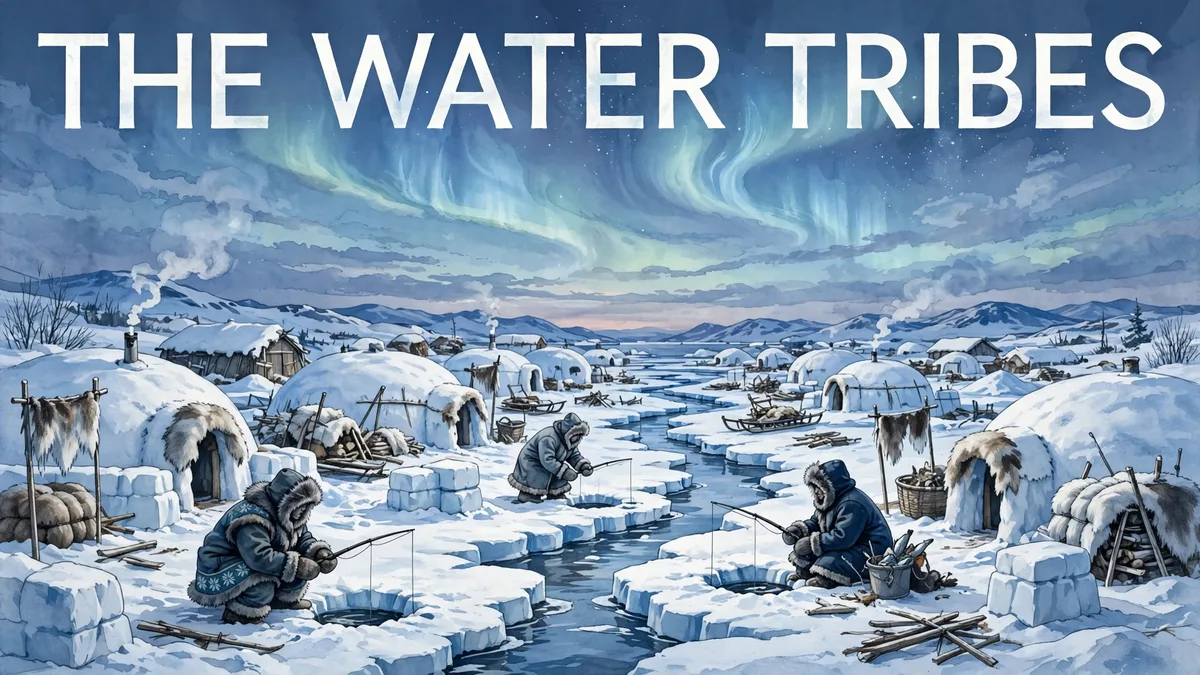
The Water Tribes draw most visibly on Inuit and Yupik culture. The fur-trimmed parkas, the animal-skin clothing, the ice fishing, the igloo-style homes of the Southern Tribe — all of it echoes Arctic Indigenous life, built for survival in a place where the cold is not scenery but the whole condition of existence. The Southern Tribe’s village, all snow and canals and ice, reads as a community shaped by its climate, not just set in it.
The details go wider than the Arctic. Sokka’s boomerang recalls Australian Aboriginal hunting weapons; Water Tribe warriors wear war paint in ways that echo Native American traditions; and the Northern Water Tribe’s grand canal city, with its walls of ice, is a polar Venice in spirit. Even the spirituality is syncretic: the moon and ocean spirits, Tui and La, pushing and pulling at each other, recall the Chinese idea of yin and yang. Waterbending itself, fluid and circular, is based on tai chi — the soft, flowing Chinese martial art whose whole philosophy is yielding and redirecting force rather than meeting it head-on.
The Earth Kingdom: China, at Continental Scale
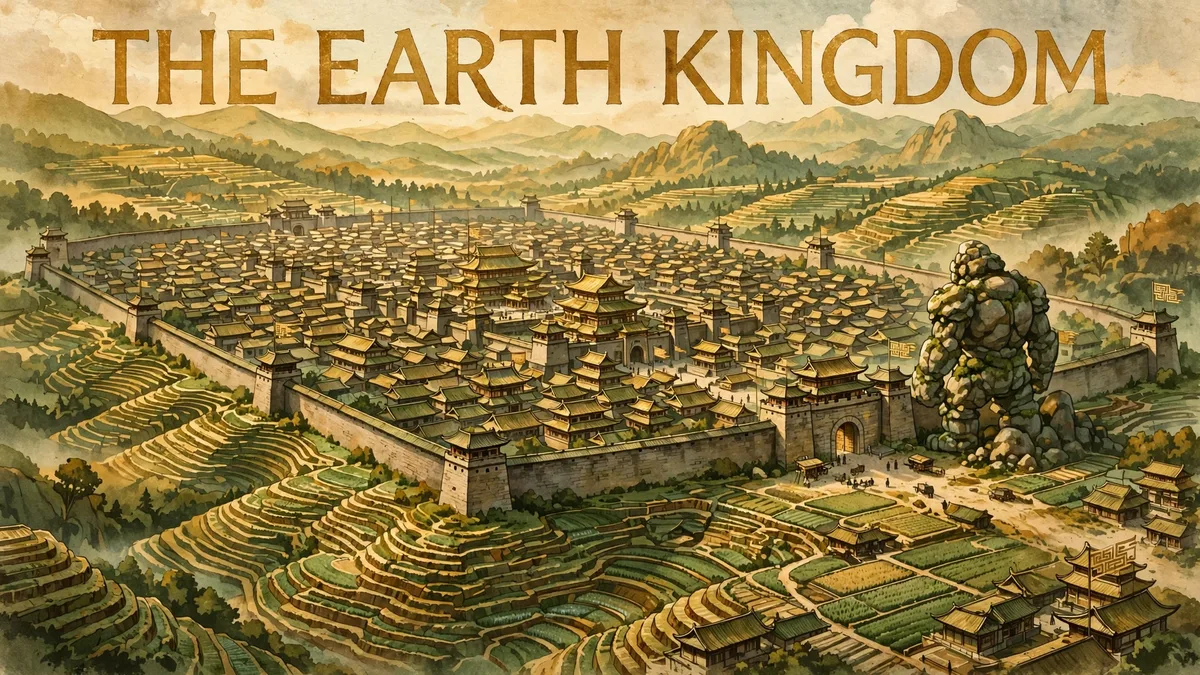
The Earth Kingdom is the show’s China, drawn at continental scale. Its architecture is Chinese in general — tiered roofs, great walls, sprawling cities — and Ba Sing Se, the capital, parallels ancient Chinese capitals like Beijing, its royal palace echoing the Forbidden City. The kingdom’s food (roast duck, jook), its clothing (largely pre-Manchu Chinese styles, with Ba Sing Se itself in Qing-dynasty mode), and its bureaucracy all point the same way. Even the darker machinery has Chinese roots: the Dai Li secret police take their name from a real leader of China’s secret police, and Lake Laogai, the brainwashing facility beneath the city, is named for re-education camps.
But the Earth Kingdom is not only China. Korean clothing, including hanbok, appears among its people; Kyoshi Island’s warriors, with their makeup, fans, and fighting style, draw on Japan; and the sandbenders of the desert resemble the Tuareg people of North Africa. The kingdom’s vastness is the point: it contains multitudes, the way a continent does. Earthbending, with its strong stances and heavy strikes, is based on Hung Gar kung fu — rooted, deliberate, and immovable, exactly like the nation that practices it.
The Fire Nation: Japan, China, and Empire
The Fire Nation is the hardest nation to pin down, and deliberately so. It is a mix of Japan and China, with Southeast Asian and other influences layered in. Its military pageantry, its island geography, its honor-duel tradition of Agni Kai, and its imperial expansion all recall imperial Japan; its palace architecture and court dress pull from China, including the shenyi robe and gardens modeled on classical Chinese ones. The Fire Temple is built like a Chinese pagoda, while Ember Island’s resorts suggest Southeast Asia.
That blend serves the story. The Fire Nation is not a stand-in for one country but for empire itself: propaganda in schoolbooks, a censored past, citizens taught they are superior and must dominate others “for their own good.” Firebending, explosive and direct, is based on Northern Shaolin kung fu, with its powerful, dynamic footwork — an art of attack, matching a nation that has been attacking for a hundred years.
The Air Nomads: Tibetan Buddhism and the Monastic Life
The Air Nomads are the show’s most directly spiritual nation, modeled on Tibetan Buddhist monks with Shaolin and Hindu influences. Their saffron robes, shaved heads, vegetarianism, and meditation practice all mirror monastic life. The method by which Air Nomad monks identify the young Avatar — presenting a child with a set of toys to choose from — parallels the way Tibetan Buddhists identify a reincarnated lama. Air temple architecture draws on Chinese Buddhist pagodas, and Aang’s own robes, particularly in the third season, resemble those of the Dalai Lama.
Airbending’s martial root is baguazhang (Ba Gua), the circular, evasive Chinese art of constant motion — the only style that fits a people who believe freedom means never being pinned down. The reincarnating Avatar itself echoes Hindu and Buddhist ideas of rebirth, and the show’s opening narration — four nations in harmony, broken by war — is a story about balance in the philosophical sense, not just the political one.
Bending Is Martial Arts — Literally
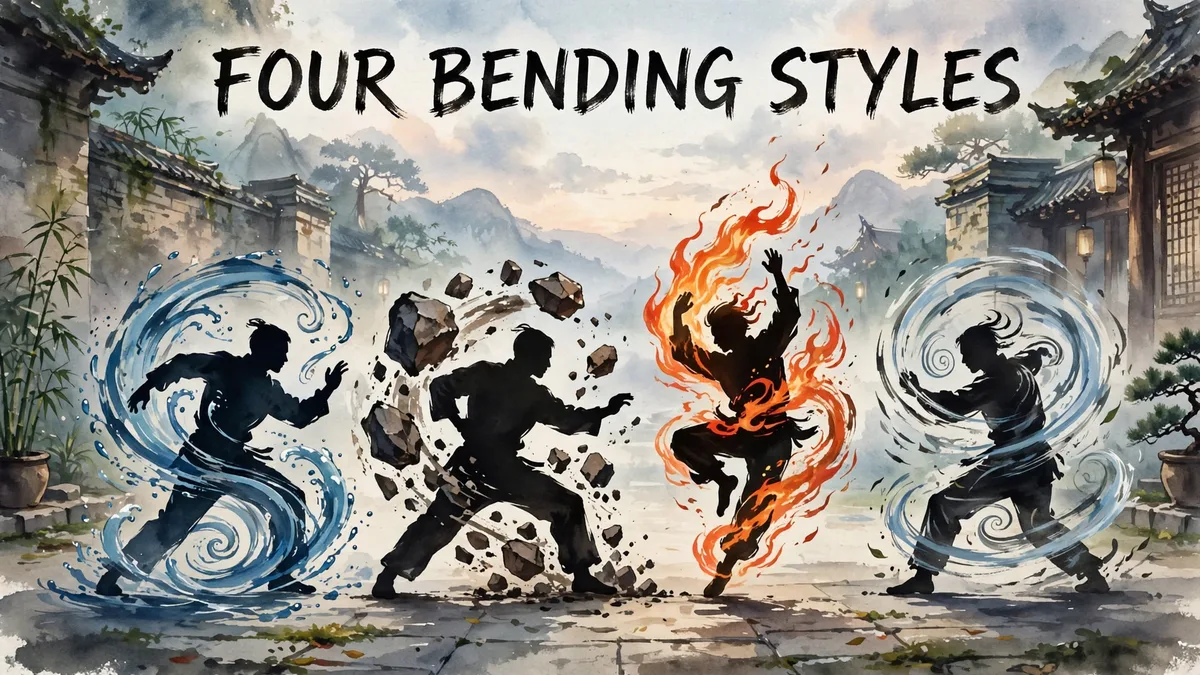
None of this is decorative. The creators hired martial-arts consultant Sifu Kisu to ground each bending style in a real discipline, and the mapping, documented in CBR’s guide to the show’s setting, is now part of the show’s legend: waterbending is tai chi, earthbending is Hung Gar, firebending is Northern Shaolin, and airbending is baguazhang. Watch any fight with that key and the choreography reads differently — Katara redirecting force like a tai chi practitioner, Toph fighting from a rooted, grounded stance that draws on Southern Praying Mantis for her close-range style, Zuko’s firebending all forward pressure and sharp angles.
The show even builds its lore around the idea that bending was learned from the natural world: air from the sky bison, earth from the badgermoles, fire from the dragons, and water — uniquely — from the moon and the tides themselves. That is why waterbending swells under a full moon and why the moon’s death in the first season’s finale is a catastrophe, not a setback.
What the Show Gets Right — and Its Limits
Avatar deserves its reputation for respectful borrowing, and the praise it gets for worldbuilding is earned: the research shows in the costumes, the food, the fighting, and the philosophy. But it is worth saying plainly what the show is not. It is an American-made fantasy that borrows across cultures; the nations are blends, not representations, and no single real people should be read as “the” Water Tribe or “the” Fire Nation. The show’s strength is that it treats its sources as living traditions to learn from — the martial arts are real disciplines, the monastic practices are real practices — rather than as exotic decoration.
That is also why the world still has room to grow. Why Avatar is still relevant is not only a question about nostalgia: it is about a world built carefully enough that a new series, Avatar: Seven Havens, can inherit it and ask new questions of it. The cultural foundations laid in 2005 are still holding up the story in 2026 — which is the best test any invented world can pass.