
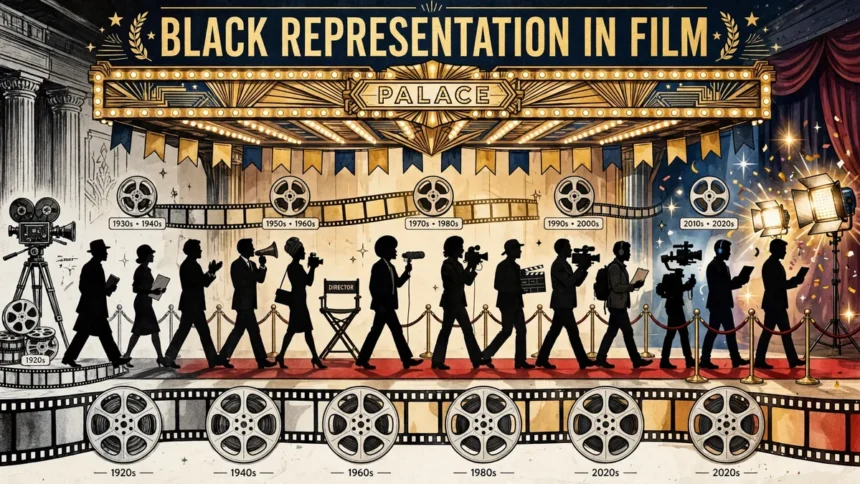
Black Representation in Film: A Complete History Guide
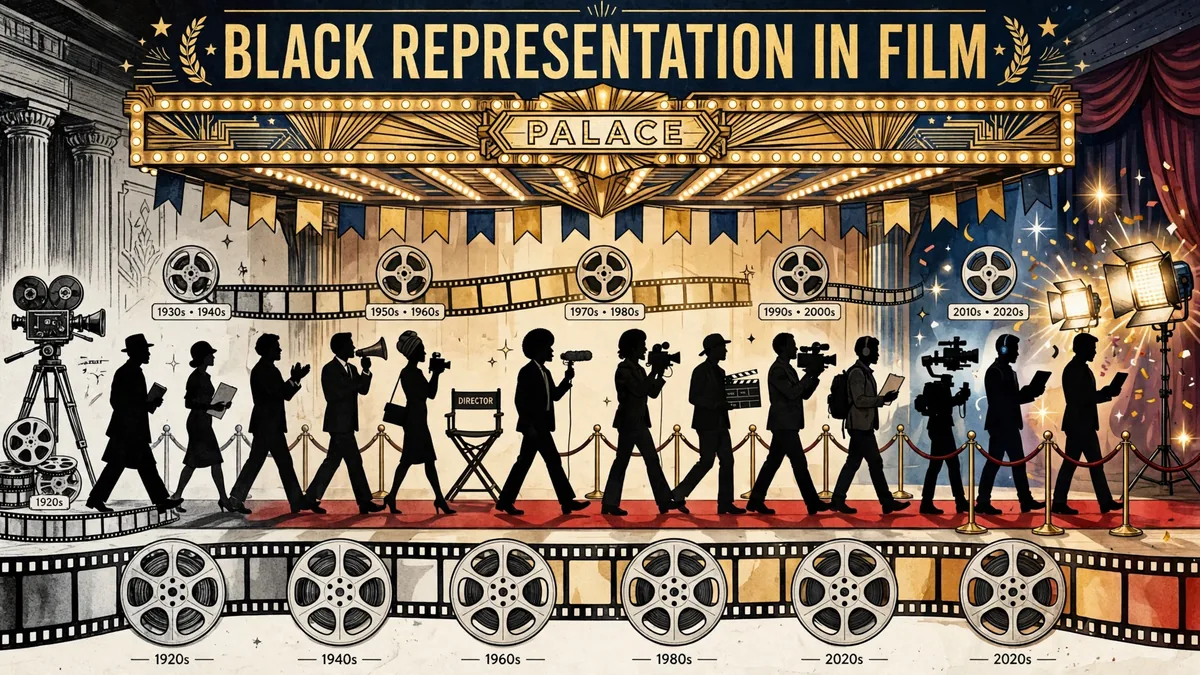
AI-generated illustration; unofficial artwork
Black representation in film is not just about who appears on screen. It is about who gets to be the hero, the lover, the genius, the ordinary person having an ordinary day — and who, for decades, was only allowed to be the servant, the sidekick, or the joke. The history below runs from segregated screens to the modern blockbuster era, and it explains why a single casting announcement can still start a culture-wide argument. For a recent example of what representation looks like when it works, start with our Sinners analysis, then come back for the full century.
What does Black representation in film actually mean?
Representation has two halves, and both matter. The first is presence: are Black people on screen at all, and in what kinds of roles? The second is power: who writes, directs, produces, and greenlights the stories? A film can have a Black cast and still be told through someone else’s gaze. The best eras of Black cinema are the ones where both halves moved together — Black performers in front of the camera and Black filmmakers behind it.
The early years: blackface, race films, and Oscar Micheaux
Mainstream American cinema began by excluding Black performers and then caricaturing them. White actors in blackface played Black characters as unintelligent or dangerous, and early Hollywood limited Black actors to servants, porters, and musicians. The response was a parallel cinema: so-called race films, made for segregated Black audiences between roughly 1915 and 1952, numbering nearly 500 films. At the center of that movement was Oscar Micheaux, the first major Black filmmaker, who wrote, produced, and directed more than 40 films between 1919 and 1948. His first feature, The Homesteader (1919), was the first feature film written, produced, and directed by a Black filmmaker — made because Hollywood would not tell these stories, so Black audiences built their own industry to tell them.
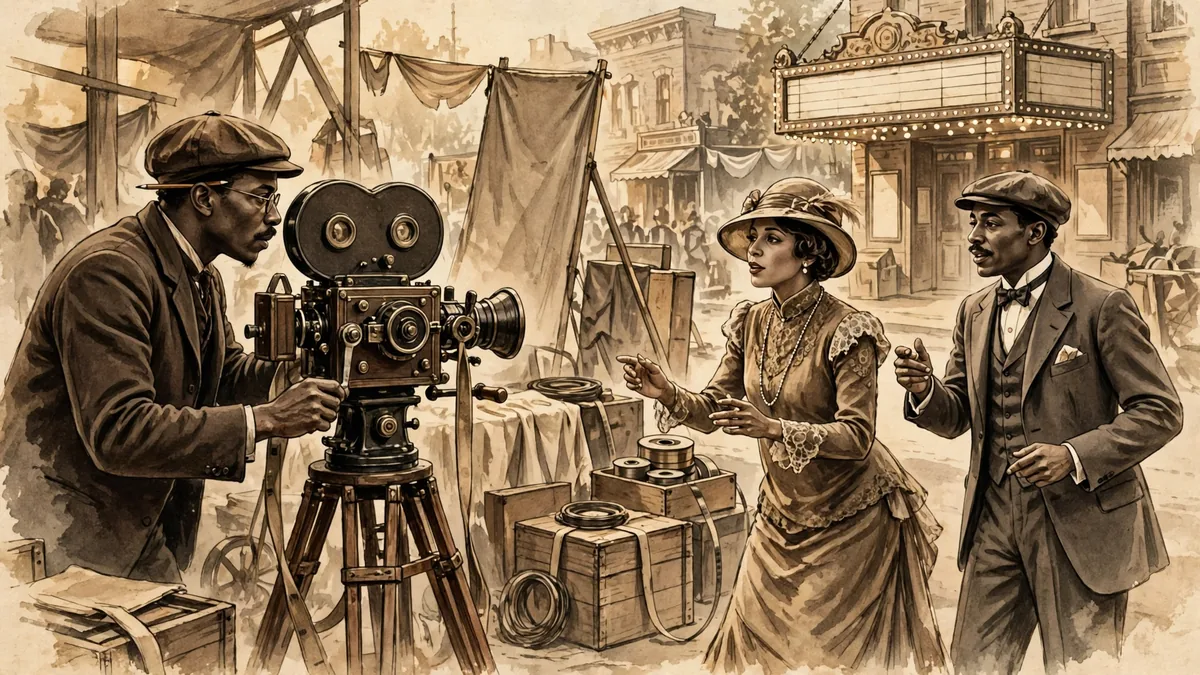
AI-generated illustration; unofficial artwork
The NAACP was already fighting the screen in 1915, protesting D.W. Griffith’s The Birth of a Nation — a reminder that the argument over who gets to represent Black life on film is as old as feature filmmaking itself.
Breakthroughs — and their limits
The first Academy Award won by a Black performer shows both the breakthrough and the limit in one night. Hattie McDaniel won Best Supporting Actress for Gone with the Wind (1939) at the ceremony on February 29, 1940 — the first Black person ever to win an Oscar. She won it playing Mammy, a servant, and she was seated at a segregated table away from her white co-stars. A door had opened, but only a crack.
The next cracks took decades. Dorothy Dandridge became the first Black performer nominated for Best Actress, for Carmen Jones (1954). Sidney Poitier became the first Black man to win Best Actor, for Lilies of the Field (1963), at the 1964 ceremony — 24 years after McDaniel’s win. Poitier’s stardom in the 1960s, including In the Heat of the Night and Guess Who’s Coming to Dinner (both 1967), proved a Black leading man could carry a mainstream hit. It did not, on its own, change who ran the studios.
The 1970s to the 1990s: taking the camera
The 1970s brought Blaxploitation: low-budget films with Black heroes at the center, launched by Melvin Van Peebles’s Sweet Sweetback’s Baadasssss Song (1971) and carried by Shaft (1971) and Super Fly (1972). The genre is still argued over — empowerment or stereotype, sometimes both in the same film — but it proved Black-led films could make money, and that proof mattered.
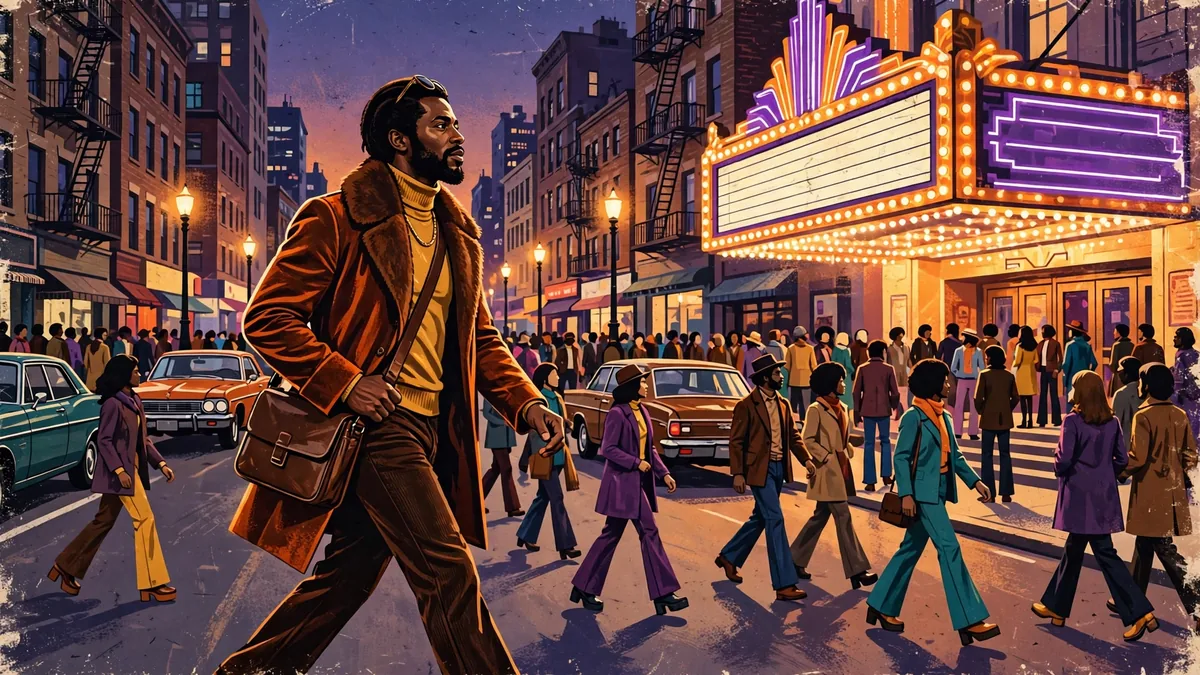
AI-generated illustration; unofficial artwork
The 1980s and 1990s put Black directors at the center of American cinema. Spike Lee broke through with She’s Gotta Have It (1986) and followed it with Do the Right Thing (1989) and Malcolm X (1992). John Singleton’s Boyz n the Hood (1991) made him the youngest Best Director nominee in Oscar history and the first Black person nominated in that category. Denzel Washington, who had already won for Glory (1989), became the industry’s leading Black dramatic actor. The stories were no longer only about proving Black people belonged on screen; they were about Black neighborhoods, Black families, and Black interior lives, told by the people who had lived them.
The modern reckoning: #OscarsSoWhite, Moonlight, Black Panther
Progress, it turned out, was not a straight line. On January 15, 2015, activist April Reign coined #OscarsSoWhite after all 20 acting nominees for that year’s Academy Awards were white. It happened again in 2016, and the hashtag became a movement, pushing the Academy to pledge to diversify its membership. The films that followed showed what was at stake: Barry Jenkins’s Moonlight (2016) won Best Picture at the 2017 ceremony, a quiet, artful film about a gay Black man growing up in Miami. Ryan Coogler’s Black Panther (2018) became the first superhero film ever nominated for Best Picture, winning three Oscars from seven nominations. Jordan Peele’s Get Out (2017) turned horror into a vehicle for talking about race — and won Peele the Original Screenplay Oscar.
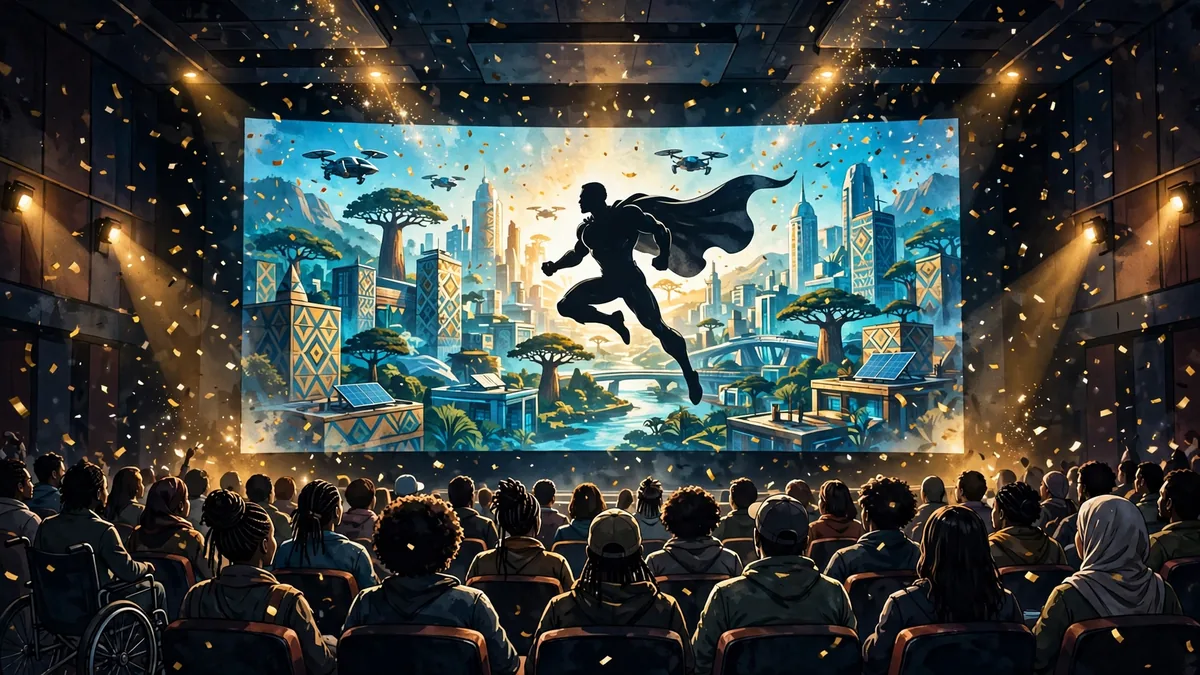
AI-generated illustration; unofficial artwork
What still needs fixing
Three gaps remain, and they are the ones our own coverage keeps returning to. First, colorism: lighter-skinned performers still get cast over darker-skinned ones, a pattern our colorism in Hollywood casting guide traces through three case studies. Second, the burden of strength: Black women on screen are still too often allowed to be strong or vulnerable, never both, which is why the strong Black woman trope persists. Third, the everyday details: hair, dialect, family life — the textures covered in our Black natural hair on TV guide — still get flattened when the people making the decisions have never lived them.
None of that erases the century of work above it. From Micheaux’s race films to McDaniel’s segregated table, from Poitier’s breakthrough to the #OscarsSoWhite reckoning, Black representation in film has moved from asking to be seen to demanding to be the author. The next chapter will be written by who holds the camera — and, increasingly, by audiences who refuse to accept anything less than the full picture.
Sources: Wikipedia, African American cinema; Wikipedia, #OscarsSoWhite.