
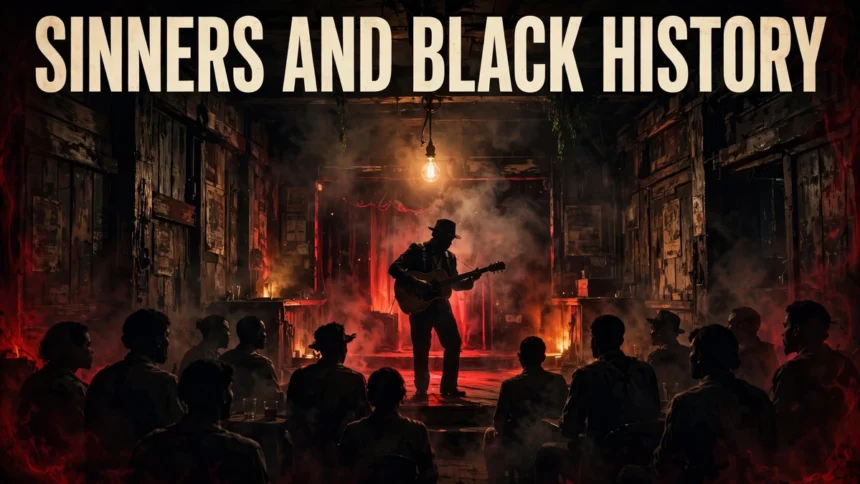
Sinners (2025): What Ryan Coogler’s Vampire Epic Says About Black History
Ryan Coogler made a vampire movie — and the vampires might be the least supernatural thing about it. Sinners (2025), written, directed, and produced by Coogler, arrived in theaters on April 18, 2025 and became a genuine phenomenon: a period horror film about twin brothers, a juke joint, and the blues that carries the weight of Black American history inside every frame. This sinners movie 2025 analysis breaks down what the film is actually saying — the symbolism of the vampires, the meaning of the juke joint scene, and why it matters.
Spoiler warning: this is a full analysis, not a review — plot details follow. If you haven’t seen the film yet, come back after.
And if Coogler’s name on an ambitious Black genre project has you hungry for more, it’s worth noting he’s not the only filmmaker thinking this big — we’ve been tracking everything we know about the Children of Blood and Bone movie, another Black-led fantasy epic on the horizon.
What is Sinners about?
The facts first. Sinners is set in 1932 in the Mississippi Delta — specifically Clarksdale. Michael B. Jordan plays dual roles as Elijah “Smoke” Moore and Elias “Stack” Moore, identical twins and World War I veterans who spent years working for the Chicago Outfit. They return home with money stolen from gangsters, buy a sawmill from the racist landowner Hogwood, and open a juke joint for the local Black community.
Their cousin Sammie (Miles Caton), an aspiring guitarist, joins them despite his pastor father Jedidiah’s warnings that blues music is supernatural. The twins recruit Delta Slim (Delroy Lindo), an old piano player, as a performer; Smoke’s partner Annie (Wunmi Mosaku), a Hoodoo practitioner, as cook; and Cornbread (Omar Miller) as bouncer. Stack’s white-passing ex-girlfriend Mary (Hailee Steinfeld) is also in town. On opening night, Sammie’s transcendent performance summons the attention of Remmick (Jack O’Connell), an Irish vampire hiding from Choctaw vampire hunters — and the night turns into a siege. The film’s credits are unambiguous about its authorship: it’s an original story written and directed by Coogler, not adapted from anything (the film’s Wikipedia page lays out the full production background).
What do the vampires symbolize?
This is where sinners movie symbolism gets rich — and where Coogler’s real argument lives. The vampires aren’t just monsters. They’re a metaphor for cultural appropriation, played out as horror.
Remmick doesn’t just want blood. He wants Sammie’s music. He promises to leave the joint alone in exchange for Sammie, whose musical gifts he needs to summon the spirits of his own lost community. Read that again: a centuries-old white creature wants to harvest a Black teenager’s art to heal his own people’s wound. The film stages, in literal terms, the oldest story in American music — Black innovation extracted by white hands. Elvis and rock and roll. The record executives who made fortunes off blues while the bluesmen died broke. The vampire offers Sammie what every exploitative industry offers: a seat at the table that is actually a cage.
There’s a second layer, too. Remmick promises the survivors that vampirism offers “immortality and freedom from persecution” — everyone equal, everyone undead. It’s the false promise of assimilation: surrender what makes you you — your culture, your difference, your music — and we’ll let you live. The film’s answer is unambiguous. The characters who survive do so by refusing the offer.
None of this is stated in dialogue as a thesis — it’s interpretation, and viewers can disagree about how far it extends. But the plot mechanics back the reading: the monster’s hunger is specifically for Black art, not just Black blood.
What does the juke joint scene mean?
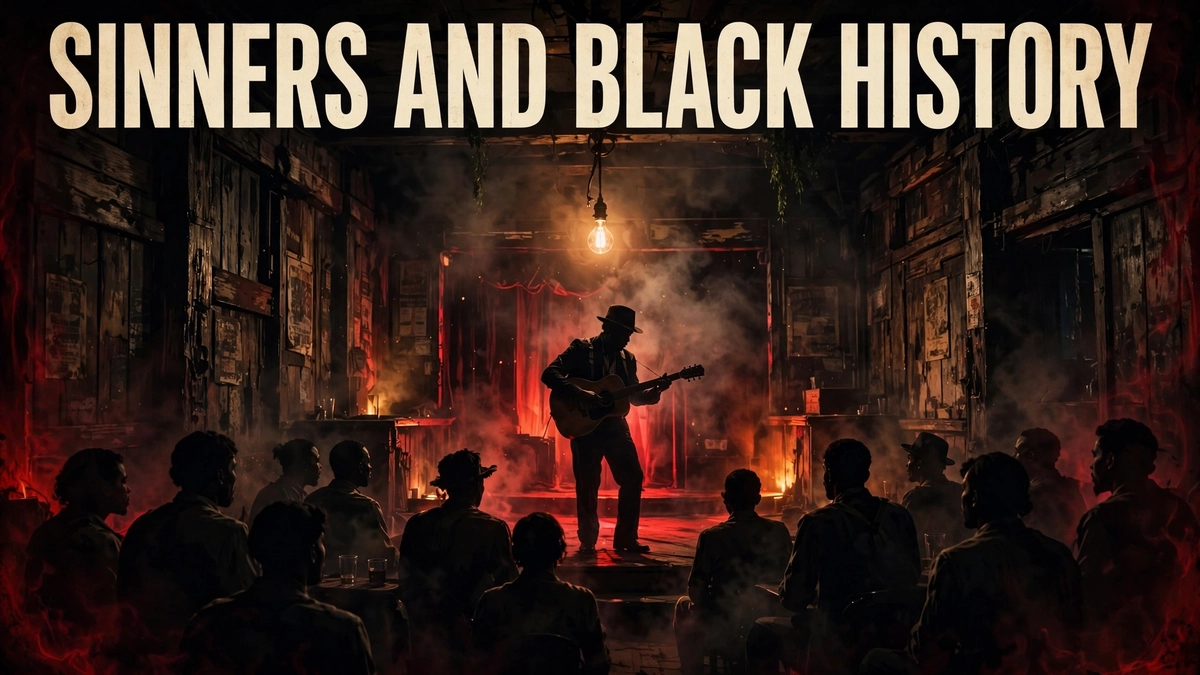
The sinners juke joint scene — Sammie’s opening-night performance — is the film’s centerpiece, and Coogler treats music as something closer to physics than entertainment. When Sammie plays, his music literally summons spirits of both past and future to join the crowd: ancestors and descendants appearing in the room, joined across time by the same song.
That’s not just a cool visual. It’s the film’s theory of the blues: Black music as a technology that collapses time, carrying the community’s history forward and its future backward. The juke joint itself matters here too. In the Jim Crow South, where Black people were barred from nearly every public space, the juke joint was one of the few rooms that was theirs — built with stolen money, yes, but built by them and for them. It’s Black joy as infrastructure. That’s why the vampires attack it: they can’t create that room, so they have to consume it.
It’s also why the threat to the joint doubles as a threat to a whole way of being. The same tradition — Black music as liberation technology, from the spirituals to Sun Ra claiming he was from Saturn — runs through our beginner’s guide to Afrofuturism, which starts with the music for a reason: before Black people imagined futures in fiction, they imagined them in sound.
How does Sinners handle Black history?
Carefully — and with more historical literacy than most horror films bother with. Four threads:
The Jim Crow South is the setting, not the backdrop. The supernatural evil is the plot, but the human evil is real: Hogwood, the landowner who sells the twins the sawmill, heads the local Klan and plans to attack the joint at dawn. The vampires are terrifying, but the film never lets you forget that in 1932 Mississippi, the living were already dangerous.
The blues are sacred, not decorative. The film treats the blues the way Jedidiah fears it — as genuinely powerful. Coogler’s composer Ludwig Göransson scored the film on a 1932 Dobro Cyclops resonator guitar, and Coogler sent him recordings of Robert Johnson and Tommy Johnson during pre-production. The music isn’t atmosphere; it’s the film’s thesis about what Black art does.
Appropriation is the film’s economic argument. A Harvard Law School Program on Negotiation analysis of Coogler’s famous deal connects the film’s themes directly to the real history of Black blues musicians — Bessie Smith, Robert Johnson — being swindled out of royalties by record companies. Coogler himself told IndieWire that given the film’s subject matter, fighting for ownership of his own film “makes sense.” The vampire who wants Sammie’s music and the record executive who wanted Robert Johnson’s royalties are the same creature wearing different clothes.
Spirituality is plural, and Black. Annie’s Hoodoo practices are treated with complete respect — she believes her work kept the twins safe, and the film never frames her as superstition. She stands opposite Jedidiah’s Christianity not as its enemy but as an older, parallel truth. And crucially, Annie isn’t a flattened symbol: she has grief, knowledge, and a will of her own — the opposite of the one-dimensional strong Black woman trope we broke down last month, where Black women get endurance but no interior life. Annie gets both.
Is Sinners based on a true story?
No — but it’s built from true things. There was no Smoke and Stack Moore, no Remmick, no vampire siege in 1932 Clarksdale. The characters and the plot are Coogler’s original invention. What is real: the Jim Crow South it depicts, the blues culture it centers, the juke joint as a Black institution, and the long history of Black music being extracted by white industries. The film is fiction that tells the truth — which is arguably what the best horror has always done.
Why Sinners matters
Two reasons — one on screen, one off it.
On screen: Ryan Coogler’s Sinners grossed roughly $364 million worldwide against a $90–100 million budget, becoming one of the highest-grossing films of 2025 — proof, again, that audiences will turn out for original Black stories told at the highest craft level. Shot on 65mm film in IMAX and Ultra Panavision 70, with a fifth Coogler–Jordan–Göransson collaboration behind the camera, it’s a film that treats Black genre storytelling as prestige cinema, full stop. It also lands in a live industry conversation about representation: who gets cast in Black stories, whose faces the industry considers “universal,” and what it costs when it gets it wrong — the pattern we mapped in our explainer on colorism in Hollywood casting.
Off screen: Coogler reportedly negotiated a deal that was almost unheard of in modern Hollywood — first-dollar gross participation, final cut, and ownership of the film reverting to him 25 years after release. The Harvard Program on Negotiation’s analysis of the deal notes it was “rare in an age when building a library of intellectual property is more valuable for studios than ever before” — and that Coogler called it deeply personal, tied to a film about who gets to own Black art. The vampire wants Sammie’s music. The director refused to let the studio keep his film. You don’t have to squint to see the rhyme.
Sinners will be argued about for years — that’s what happens when a horror film doubles as a history lesson and a business lesson at once. If it sends you looking for more worlds built from Black imagination rather than Black suffering, start with our guide to Black fantasy books — twelve novels where Blackness is the engine of the story, not the obstacle.