
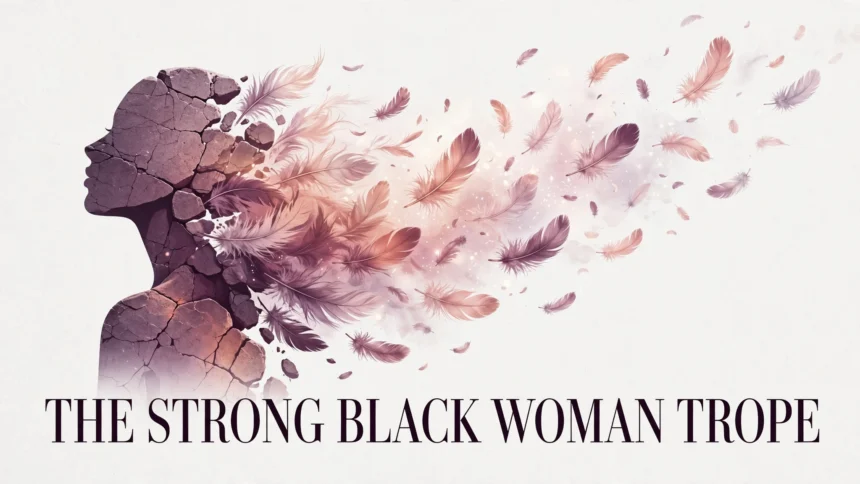
“She’s so strong.” It’s meant as a compliment — and Black women have heard it so often it can start to sound like a job description. The strong Black woman trope is the expectation that Black women endure anything without breaking: no tears, no rest, no help needed. It shows up in movies, in workplaces, in families, and in the mirror. This is what the trope actually is, where it came from, what the research says it costs, and what real strength looks like instead.
It’s worth saying upfront: this isn’t an argument against Black women’s strength. It’s an argument against a version of strength that denies Black women full humanity — vulnerability, rest, softness, and all. (For the fiction version of that same hunger — stories where Black women get interior lives instead of just endurance tests — see our list of books by Black authors that aren’t about being Black.)
Where the trope comes from
The strong Black woman didn’t appear out of nowhere. She was built, layer by layer, out of American history. Under slavery, Black women were forced to labor like men while being denied the protections of womanhood — then stereotyped afterward to justify it. Sociologist Patricia Hill Collins named the resulting caricatures “controlling images”: the Mammy (endlessly nurturing, never needing care herself), the Jezebel, the Sapphire — each one a way of flattening a person into a function.
The “strong” version was, paradoxically, a response to those insults. If the culture called Black women servants or shrews, then strength — independence, endurance, unbreakability — looked like the dignified alternative. But as Black feminist writers pointed out early, it was a trap with better lighting.
In 1978, Michele Wallace published Black Macho and the Myth of the Superwoman, one of the first major works to name the problem directly: the myth of the Black superwoman — a woman of inordinate strength, able to tolerate unusual amounts of misery and work — flatters Black women while invalidating their suffering and foreclosing any claim to redress. If you’re superhuman, nobody owes you care. Tamara Beauboeuf-Lafontant’s Behind the Mask of the Strong Black Woman (2009) later traced how the mask gets internalized: strength as a performance Black women feel they can’t drop.
The research: the Superwoman Schema
In 2010, nursing scholar Cheryl Woods-Giscombé gave the trope a research framework: the Superwoman Schema. Based on focus groups with Black women, she identified five characteristics: a perceived obligation to present an image of strength; a perceived obligation to suppress emotions; a perceived obligation to resist vulnerability or asking for help; the motivation to succeed despite limited resources; and prioritizing caregiving for others over self-care.
Woods-Giscombé herself called these traits a double-edged sword — strength and drive can protect women in hostile circumstances. But as Essence’s reporting on her research notes, emotional suppression and chronic self-neglect become dangerous as long-term habits. A 2025 study of 390 Black women found that the schema’s “emotion suppression” and “obligation to help others” dimensions were associated with elevated depressive symptoms — with the effect strongest among women under the most financial strain.
The cost is physical, not just emotional
This is where the trope stops being a media-criticism conversation and becomes a health one. Public-health researcher Arline Geronimus proposed the weathering hypothesis in 1992: the cumulative stress of racism and discrimination causes premature deterioration of Black women’s bodies — measurable in things like shorter telomeres, higher allostatic load, and worse maternal-health outcomes that persist across income and education levels.
Weathering isn’t caused by the trope alone. But the trope is the cultural story that makes the weathering invisible: if she’s strong, she must be fine. The expectation of endurance becomes the reason nobody checks whether she’s surviving it.
How the trope shows up in media
On screen, the strong Black woman is the character who holds everyone together and gets no arc of her own — the friend with the advice, the mother with the sacrifice, the professional with no interior life. Awards culture reinforces it: as Ebony’s archive argued in her piece on awards season, Black creativity gets recognized most reliably when it’s tied to suffering. Strength-through-pain becomes the only legible performance.
The subtler version is the compliment that functions as a cage. “You’re so strong” — said to a woman who just told you she’s drowning — translates to: I don’t have to help. The trope trains everyone, including Black women themselves, to treat vulnerability as failure.
The pushback is already happening
The most visible cracks in the trope came from Black women athletes. Naomi Osaka and Simone Biles — two of the most dominant competitors in their sports — publicly stepped back to protect their mental health, rejecting the strong-Black-woman script at the peak of their careers. Their decisions sparked a wave of Black women publicly declaring they were done performing invulnerability.
The writers saw it first, of course. The Black feminist canon — Wallace, bell hooks, Audre Lorde, and the generations after them — spent decades arguing that Black women’s full humanity includes softness, rest, anger, joy, and need. Our guide to essential Black women writers is, among other things, a map of that argument: eighteen authors who refused the mask.
What strength looks like instead
Here’s the reframe the research points to: real strength includes vulnerability. Woods-Giscombé’s own work treats help-seeking and emotional honesty as protective, not weak. The characters who resonate most — in fiction and in life — aren’t the ones who never break. They’re the ones who are allowed to.
That’s why stories about powerful women learning to be vulnerable land so hard. We’ve written about Korra’s arc as exactly this kind of story: a hero defined by power who has to learn that falling apart isn’t failure — it’s the part of the story where she becomes a person. The strong Black woman trope says you don’t get that part. Every Black woman deserves it.
So the next time you’re tempted to call a Black woman “so strong,” try the rest of the sentence: she’s strong, and she shouldn’t have to be. Then ask what she needs. That’s the compliment the trope was always missing.