
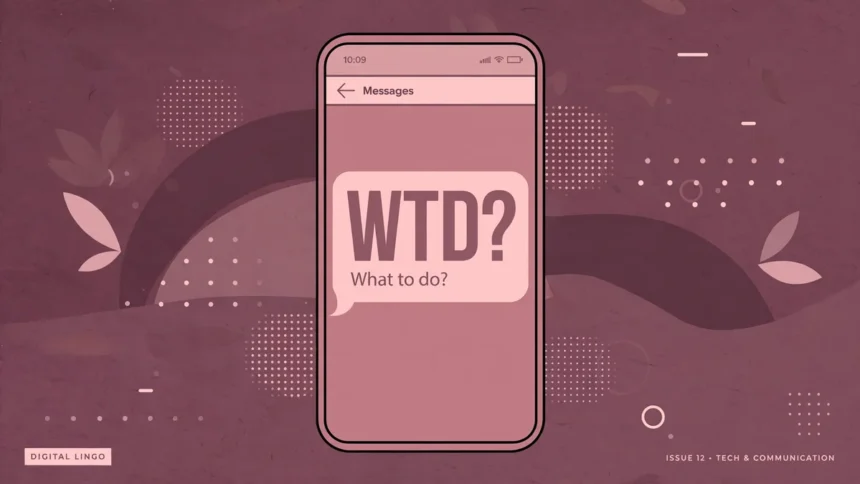
WTD, IDM and More Texting Meanings Explained
Three letters land in your messages — WTD? — and you have about two seconds to decide what the sender actually wants. Advice? An explanation? Plans for the weekend? Texting slang saves keystrokes, but it costs clarity, because most of these abbreviations carry more than one meaning. This guide covers WTD and the abbreviations people search for alongside it — IDM, JS, FML and GNG — with the most common meaning first, the context cue that settles it, and an honest flag wherever sources disagree. A few letters can carry a whole argument, which is the same shorthand-label problem we break down in our explainer on the strong Black woman trope: the short version is never the whole story.
How to use this guide: every entry below gives the meaning, a real-chat example, and how to reply. Where an abbreviation is genuinely unsettled, we say so instead of picking one expansion and pretending it is settled. Slang moves fast and varies by community, so treat every “most common” claim here as “most common across the slang guides checked today,” not a dictionary ruling.
AI-generated illustration; unofficial artwork.
What Does WTD Mean in Texting?
WTD most commonly means “What to do” or “What’s the deal?” Both readings are well attested across slang guides, and the sentence around it tells you which one applies.
As “What to do,” WTD asks for advice or direction — the sender is stuck, bored, or unsure what to do next. “I’m free all weekend and everyone’s busy. WTD?” As “What’s the deal?” it asks what is happening or what is going on, often about someone else’s behaviour. “He left the group chat mid-argument. WTD?” A less common third reading, “Why the delay?”, shows up when someone is waiting on a reply: “Sent it an hour ago. WTD?”
How to tell: if the message describes a problem or an empty schedule, read it as “What to do.” If it describes a situation or someone’s behaviour, read it as “What’s the deal?” How to reply: answer the question behind the letters — suggest a plan, or explain what happened. If you genuinely cannot tell, ask: “Do you mean what should we do, or what happened?” That beats guessing.
What Does IDM Mean in Text?
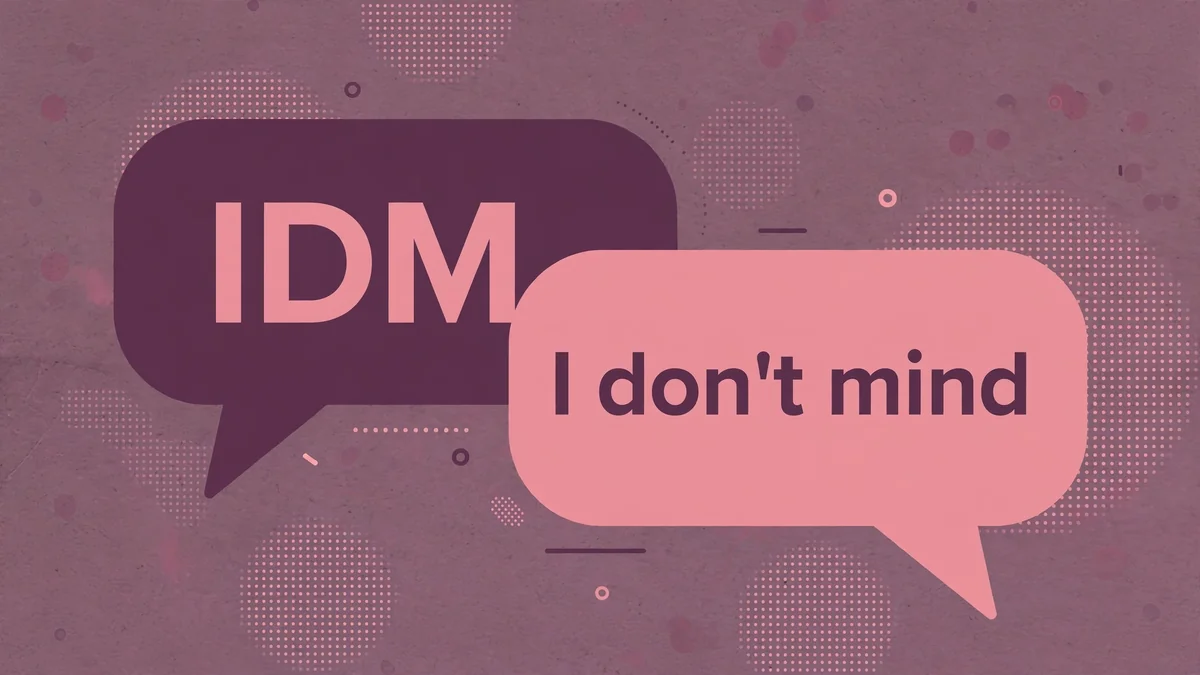
IDM means “I don’t mind.” This one is settled. It signals agreement without a strong preference: the sender is fine with whatever you suggested, or at least not opposed to it.
“Want pizza or tacos?” — “IDM, either works.” Tone does the rest of the work. Flat and one-word, IDM can read as indifference; with an exclamation or a follow-up suggestion, it reads as easygoing. How to reply: if you need an actual decision, ask for one: “Okay, but which do you actually want?” Do not confuse texting IDM with the technical uses of the same letters — Intelligent Dance Music and Internet Download Manager are different worlds, and neither belongs in a chat about dinner.
AI-generated illustration; unofficial artwork.
JS Meaning in Text: Just Saying
JS means “just saying.” It usually sits at the end of a sentence as an opinion softener — a way of offering a thought while pretending not to insist on it. “That movie was two hours too long, JS.”
Mid-sentence, JS also works as shorthand for the plain word “just”: “I js got home.” Either way, the function is the same: keep it casual, keep it light. How to reply: take the opinion at face value and respond to it, not to the softener. JS is not an apology and it does not cancel what came before it.
FML Means in Texting: What It Means, and Why We Censor It Here
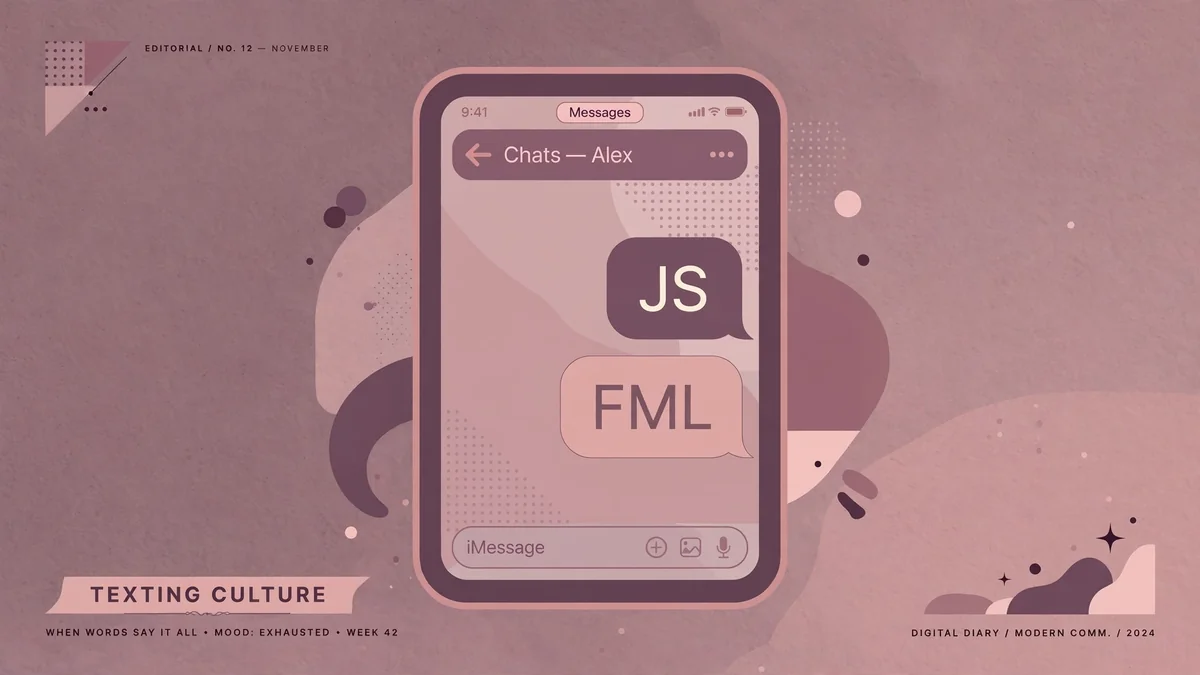
FML stands for “f*** my life.” We print it censored in this guide because the full expansion is profane; the abbreviation itself is the search term, and the meaning is what readers came for. It punctuates a story about bad luck — usually after an unfortunate anecdote, often with playful exaggeration rather than genuine despair.
As How-To Geek’s explainer notes, FML usually comes at the end of a story about something unlucky that happened to the sender, as a way of punctuating how bad it felt. “Studied all week, overslept, missed the exam. FML.” It can be funny, ironic, or genuinely angry depending on what came before it. How to reply: match the tone of the story, not the letters. A small mishap wants sympathy or a laugh; a real crisis wants a real response, not a meme.
One caution: FML reads as venting, not as a request for help. If a friend uses it about something serious, check in properly instead of assuming the joke landed.
AI-generated illustration; unofficial artwork.
What Does GNG Stand For? The Vowel-Drop Correction
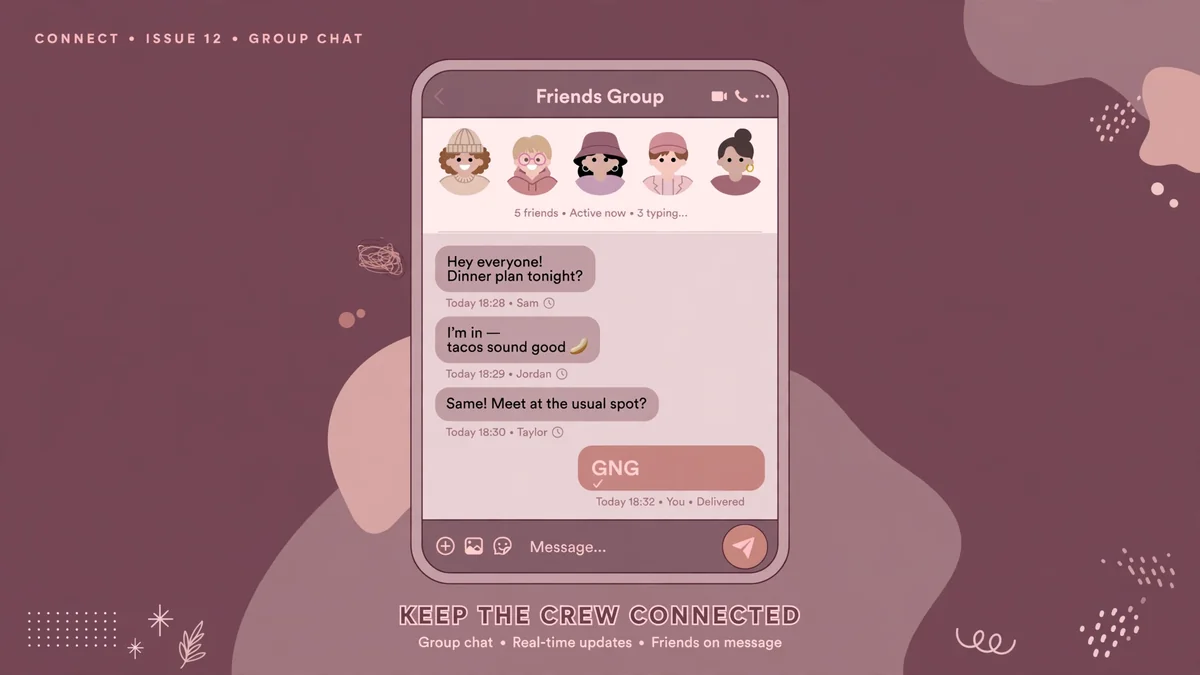
GNG is not really an acronym — it is “gang” with the vowel dropped. That correction matters, because asking “what does GNG stand for” assumes each letter expands to a word, and here it does not. GNG addresses a friend group or circle, the way “fam” or “bro” addresses a person: “What’s up, GNG?”
Two secondary readings exist. “Going,” as a shortened spelling: “Where are you GNG?” And “good night gang,” as a group-chat sign-off. Group chats argue over implied meaning the way fandoms argue over a single scene — our breakdown of the Zutara vs Kataang ship war is a twenty-year case study in how one moment gets read two opposite ways, and GNG works the same way at chat scale.
How to tell: at the start of a message to a group, it is almost always “gang.” At the end of the night, it may be the sign-off. How to reply: answer the group, not the letters.
AI-generated illustration; unofficial artwork.
Where a Lot of This Slang Comes From
Internet slang is not invented in a vacuum. Wikipedia’s overview of internet slang notes that it has borrowed heavily from African-American Vernacular English (AAVE), a borrowing that scholars and commentators have also flagged as appropriation when the origin goes uncredited. That history is worth knowing before repeating any of these terms: the shorthand travelled from Black speech and Black online communities into mainstream texting, often without the credit. Black speech has shaped mainstream screen dialogue for a century too, a history traced in our guide to Black representation in film — the words change, the pattern of borrowing does not.
Quick Reference: WTD, IDM, JS, FML, GNG
| Abbreviation | Most common meaning | Context cue |
|---|---|---|
| WTD | What to do / What’s the deal? | Problem or empty plans = advice; a situation = explanation |
| IDM | I don’t mind | Agreement without a preference |
| JS | Just saying | Opinion softener, usually sentence-final |
| FML | F*** my life (censored) | Bad-luck story, playful or genuinely frustrated |
| GNG | Gang (vowel-drop), not an acronym | Addressing a friend group; sign-off at night |
Still unsure when a message lands? Read the sentence around the abbreviation before the abbreviation itself. And if you write fiction or fan discussion, remember that hearing a voice on the page matters as much as decoding it in a chat — the books by Black authors that aren’t about being Black on our list are a good place to hear how natural dialogue actually sounds when writers get it right.