
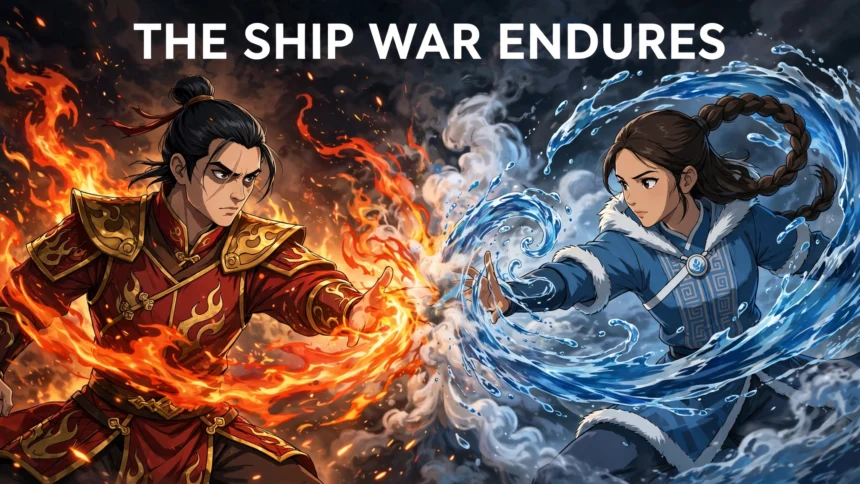
Zutara vs Kataang: Why the Ship War Still Burns
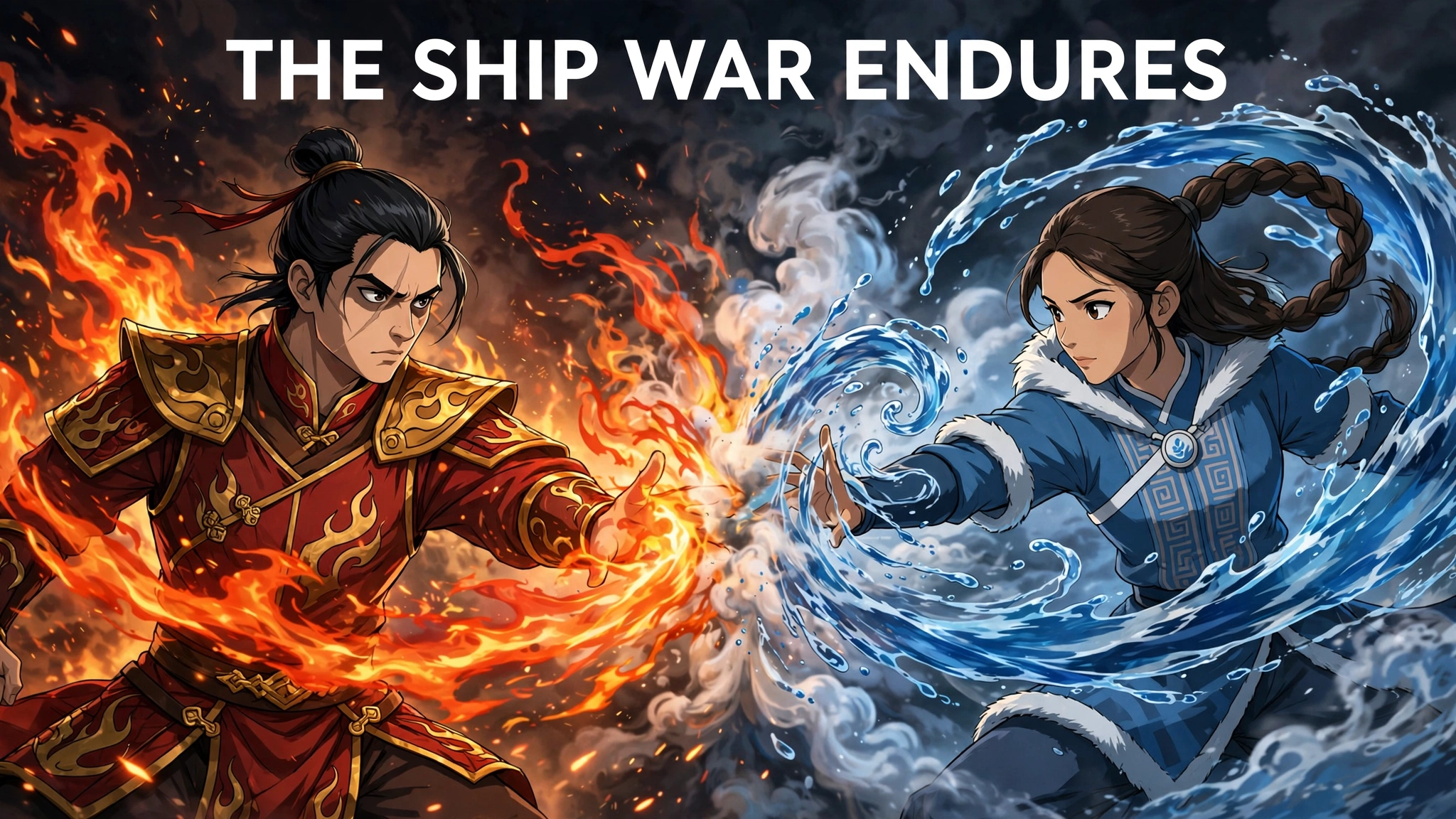
Few fandom debates have the shelf life of Zutara vs Kataang. Avatar: The Last Airbender ended in 2008, Kataang — Aang and Katara — became canon in the final shot, and yet the Zuko-and-Katara ship not only survived the loss, it thrived on it. Fanlore, the fandom-history wiki, classifies Zutara as a “juggernaut ship”: one of the most popular pairings in the fandom that never became canon. Nearly two decades of debate, fanfiction, and fanart later, the war is still burning — and, as Ebony Purks argued in her original pro-Zutara essay, the case for Zuko and Katara was never frivolous. This is an even-handed look at why each side believes what it believes, the canon moments both camps claim, and why neither will ever surrender.
The case for Zutara
Zutara shippers point to a relationship built on mutual transformation. Zuko and Katara begin as enemies — he hunts her friend and her family across the world — and end as the two people who understand each other’s wounds best. The ship’s case rests on a few pillars:
- Mirrored trauma. Both lost their mothers to the Fire Nation’s war (Zuko’s mother banished, Katara’s mother murdered), both carry the weight of families torn apart, and both mature into leaders. Zutara fans argue theirs is a pairing of equals — two teenagers who grew up too fast — where Katara reads Aang as a little brother she raised.
- The redemption payoff. Zuko’s redemption arc is the spine of the whole series, and Katara is its final gatekeeper. In “The Southern Raiders,” Zuko sits outside her tent all night, then helps her hunt down the man who killed her mother — not to enable revenge, but to earn the forgiveness she refuses to grant him. She chooses mercy and embraces him. For Zutara fans, that episode is the emotional climax of the show.
- Chemistry, not comfort. Where Kataang is built on years of easy friendship, Zutara shippers see fire: two headstrong, passionate people whose dynamic is tense, dramatic, and narratively symmetrical — fire and water, the show’s elemental thesis, in human form.
None of this is invented; the show kept feeding the reading. Season 3 put Zuko in regular, close contact with Katara, and episodes like “The Southern Raiders” gave shippers canon-grade material right up to the finale.
The case for Kataang
Kataang’s case is simpler and harder to argue with: it’s what the show did. Aang’s crush on Katara starts in the pilot and builds across all three books into a slow-burn, friends-to-lovers arc. Their first kiss — implied off-screen in the season 2 episode “The Cave of Two Lovers,” when the lights die and the show cuts away — becomes canon on-screen in the series finale, where the final shot of Avatar: The Last Airbender is Aang and Katara kissing at sunset after Ozai’s defeat.
Kataang shippers argue the relationship was earned the honest way: Katara is the first person who ever believed in Aang, the one who kept his compassion anchored, and the girl who thawed him out of an iceberg and into a hero. The age-gap critique (she reads as more mature) cuts both ways — shippers note she chose him anyway, freely, and The Legend of Korra confirms they married and raised three children: Bumi, Kya, and Tenzin.
For Kataang fans, the finale didn’t just settle the ship war — it revealed there was never a war. The text was always Kataang; Zutara was a compelling mirage.
The moments both sides fight over
Every ship war has its contested scripture. These are the four scenes that still generate the most heat:
1. The Cave of Two Lovers
Season 2, episode 2. Trapped in a dark cave, Katara suggests they kiss to light the way out — “love is brightest in the dark” — and the camera fades as the lights go out. Kataang fans claim it as the couple’s origin moment; Zutara fans note the show never actually shows it, and the ambiguity has fueled two decades of “did they or didn’t they” discourse. (Katara’s voice actor, Mae Whitman, has said she believes they did — which settled nothing.)
2. The Southern Raiders
Zutara’s holy ground. Zuko helps Katara confront Yon Rha, the Fire Nation officer who killed her mother. Katara bloodbends, stops the rain, raises her hand to kill — and chooses not to. Then she forgives Zuko and hugs him. Zutara shippers read a romance consummated in everything but name; Kataang shippers read a beautiful platonic resolution — forgiveness, not flirtation. And the writers knew what they were stoking: series extras have noted that “The Southern Raiders” script itself likens the two to “Mr. & Mrs. Smith,” per Fanlore’s history of the ship war.
3. The Ember Island Players
The show’s most meta episode is also its most ship-war-coded. The gang watches a Fire Nation play that dramatizes their adventures — including a version of Katara who dramatically declares her love for Zuko’s stage counterpart, while the real Zuko and Katara side-eye each other in the audience. The penultimate episode of the series (season 3, episode 17, aired July 18, 2008), it was written as a self-parody recap — but Zutara fans felt the joke crossed from teasing into mocking, and the episode remains Exhibit A in the “the writers knew exactly what they were doing” argument.
4. The finale
The canon verdict. After Aang defeats Ozai, the series ends with Aang and Katara’s kiss — and The Legend of Korra doubles down by making them a married couple with children. Kataang fans consider this case closed. Zutara fans consider it a canonical outcome they never had to accept — shipping, after all, isn’t a democracy the finale gets to rule.
Is Zutara healthier than Kataang?
This is the sharpest edge of the modern debate, and both sides answer “obviously mine.” Critics of Zutara argue the ship romanticizes a boy who hunted Katara, burned villages, and only earned trust at the eleventh hour — some anti-Zutara fans have even compared it to Reylo, the divisive Star Wars pairing, a comparison Fanlore documents in its history of the conflict. Zutara defenders counter that the entire point of Zuko’s arc is accountability: he confronts what he did, Katara sets the terms of forgiveness, and the ship is about two people who chose each other after the worst was behind them — not despite it, but through it.
Kataang has its own healthiness critics, who argue Katara’s maternal, caretaking dynamic with Aang reads more sibling than romantic. There’s no neutral answer here; the disagreement is about what a relationship is for — healing through similarity (Zutara) or growth through devotion (Kataang).
Why it never ended
Ship wars usually die when canon speaks. This one didn’t, for a few reasons. First, the show gave Zutara too much good material too late — “The Southern Raiders” airs five episodes before the finale, which is an odd place to put a ship’s emotional peak if the ship was never in play. Second, the creators themselves couldn’t stay neutral: at San Diego Comic-Con 2008, eight days after the finale, co-creators Bryan Konietzko and Michael Dante DiMartino screened a video that mocked Zutara fanart — a joke they later walked back, but the damage was done, and Zutara shippers never forgot it. Third, the post-finale rumor mill churned for years on claims — including debunked “interviews” — that head writer Aaron Ehasz had intended Zutara for a fourth season; Ehasz eventually had to caution fans in a Reddit AMA that fake interviews with him were spreading false information.
Fourth, the “receipts” genuinely cut both ways. DiMartino has said the creators “never intended for Zuko and Katara to get together” and always had “a soft spot” for Kataang — but series writers John O’Bryan and Joshua Hamilton have gone on record that the writers’ room fought over whether Katara should end up with Zuko or Aang, and M. Night Shyamalan has said that during Book Three’s production the co-creators “hadn’t even decided… who Katara was going to end up with.” When both the intended canon and a real in-room debate are documented, neither side has to be delusional — and neither ever yields. Finally, every franchise revival re-litigates it: when Avatar hit Netflix in 2020, the shipping war reignited with a flood of new fans, and when the live-action adaptation announced Katara would be aged up (briefly reported as 16 to Aang’s 12), Zutara fans dared to hope — hopes that died when the final casting kept Katara at 14 and aged Zuko up to 17.
Where the debate lives now
The debate just got a new generation of jurors. Avatar: Seven Havens — the first new Avatar series in over a decade — premiered on Paramount+ on October 9, 2026, following a new Avatar, the young earthbender Pavi, in a world that blames the Avatar for a global cataclysm. A new audience discovering the franchise through Pavi will inevitably rewind to The Last Airbender — and land, fresh-eyed, in a ship war that predates them by nearly two decades.
Early discourse suggests the old fights are already resurfacing in new form. The series puts Korra’s legacy on trial, which has revived the generational Aang-vs-Korral debates — and with them, the question of whose lineage the new era inherits. (For the record on what the new show does and doesn’t confirm about Korra, see our Korra legacy debate explainer and whether Korra appears in Seven Havens.) The Zutara vs Kataang question will be asked by viewers who weren’t born when the finale aired — and they’ll find both armies waiting, citations ready.
Maybe that’s the real answer to why the ship war still burns: canon ended the story, but it never ended the argument. Kataang won the finale. Zutara won the fandom’s imagination. And in a fandom, imagination is the home-field advantage.