
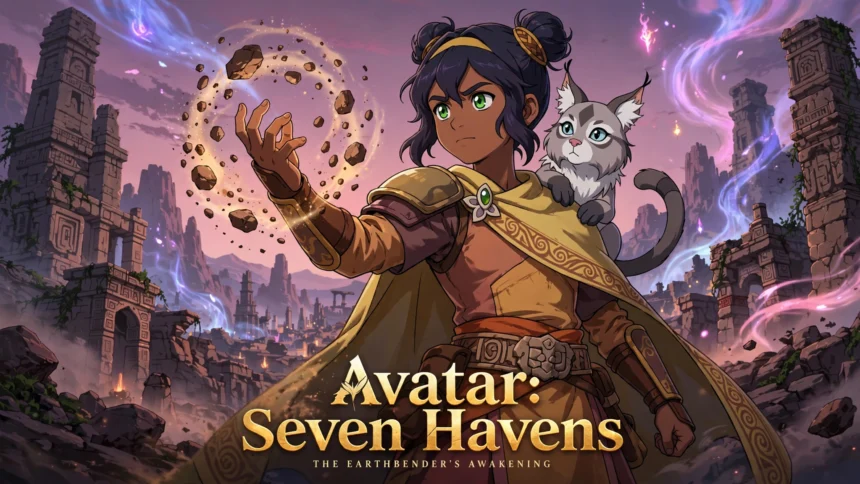
After twelve years, the Avatar is back — and the world she inherits is barely standing. Avatar: Seven Havens, the first new animated series in the franchise since The Legend of Korra ended in 2014, premiered October 9, 2026, on Paramount+, with the first three episodes of Book One: Survival. Whether you grew up on Aang, came of age with Korra, or fell into the fandom through the debates over who Katara should have ended up with, this is the premiere the fandom has been waiting for. Here is everything that is known so far — including how the premiere landed.
Release date and where to watch
Paramount+ is releasing Book One’s 13 episodes in weekly batches rather than all at once. The schedule, confirmed on Paramount+’s official series page:
- October 9 — Episodes 1–3 (“On the Horizon,” “Into the Storm,” “The Order”)
- October 16 — Episodes 4–6 (“The Faceless,” “The One Left Behind,” “Night of the Afflicted”)
- October 23 — Episodes 7–9 (“What Lies Beneath,” “The Envoys” Parts 1 and 2)
- October 30 — Episodes 10–13 (“Ghosts and Spirits,” “Battle of the Ruins,” “The Dome,” “The Root Chakra”)
The series was originally expected in 2027, but the date was moved up — it now arrives on the same day the Avatar Aang: The Last Airbender film was originally scheduled to release. A second season was already ordered — and on premiere day, Paramount+ went further, announcing seasons 3 AND 4 during the New York Comic-Con panel.
What is Avatar: Seven Havens about?
The series jumps 225 years past the end of The Legend of Korra — the longest time skip in franchise history — into a world that has been shattered by a cataclysmic event. The portals between the human and spirit realms have opened, spirits overrun the land, and civilization has contracted into seven fortified settlements: the Seven Havens, the last strongholds of civilization.
Into this wreckage is born Pavi, a nine-year-old earthbender living in hiding in the canyon city of Ellora, who learns she is the next Avatar after Korra. But in this era, the title is a curse, not an honor: the Avatar is feared as humanity’s destroyer rather than its savior. Hunted by human and spirit enemies alike, Pavi reunites with her long-lost twin sister, Nisha. Together they must uncover the mystery of their origins and save the Havens before civilization collapses entirely.

The inversion is the hook. Every previous Avatar story began with a world that needed saving and a hero it could believe in. This one begins with a world that blames the Avatar for its ruin — a premise that turns the franchise’s moral compass inside out, and one that echoes the way The Legend of Korra’s villains became more compelling than its heroes.
Meet the new Avatar: Pavi and the cast
Pavi, voiced by Saheli Khan, is the youngest Avatar protagonist the franchise has ever centered — and one of its most striking. Reports describe her as a nine-year-old earthbender who is missing a leg, an underdog in every sense, surviving in a world that sees her title as proof of doom. Her twin sister Nisha (Aishu Devan) joins her on the journey to uncover their mysterious origins.
The supporting cast includes Major Curda as Jae, an airbender traveling with the twins; Dee Bradley Baker — the voice of Momo and Appa in the original series — as Geet and Ruhi, the twins’ cat-monkey companions; Akshay Khanna as Karthik; Sakina Jaffrey as Agam; Darren Barnet as Daemin; and Dianne Doan as Zi.
Behind the scenes, the original creators Michael Dante DiMartino and Bryan Konietzko are back as creators and executive producers, alongside Ethan Spaulding and Sehaj Sethi. Jeremy Zuckerman, who scored both previous series, returns for the music, and the animation comes from La Chouette Compagnie, with art direction said to draw on the French surrealist Mœbius and 1990s anime. The cast is drawn primarily from South Asian performers — a deliberate choice for a series whose cosmological framing leans into Hindu concepts of cosmic cycles, and a notable statement about who gets to anchor a major animated franchise in 2026.
How the premiere landed
The first three episodes landed on Paramount+ on October 9, and the early verdict is strong: 100% on Rotten Tomatoes from 16 critics (average 8.2/10) and the low 80s on Metacritic — “universal acclaim.” TheWrap, reviewing the first six episodes, called it a standout spinoff worth the wait, praising the writing, world-building, and Jeremy Zuckerman’s score; But Why Tho gave the opening three a 9.5/10. The recurring caveat across reviews is the animation — simpler than Korra’s, from French studio La Chouette Compagnie — though the art direction (Mœbius and 1990s-anime influences) earns its own praise. Audience response is cooler than critics’: Metacritic’s user score sits around 6.3, so expect a “critics love it, fans divided” weekend. And Paramount+ is committing big — seasons 3 AND 4 were announced during the New York Comic-Con panel on premiere day. The rest of Book One: Survival arrives in batches October 16–30.
Why this premiere matters
This is not a nostalgia cash-in. It is the franchise’s biggest creative swing: a child Avatar the world fears, a post-apocalyptic setting, and a 225-year jump that frees the story from the baggage of the past while keeping its soul. The first trailer reportedly includes a Korra cameo, and ScreenRant reports the return of one of Korra‘s most controversial villains — a tantalizing prospect for anyone fascinated by the line between villain and anti-hero, which this site has argued is where the most interesting stories live.
For longtime readers: the old site’s biggest traffic came from its Avatar-era writing, and the franchise has finally caught up to the questions those pieces were asking — about power, legitimacy, and who gets to decide what a hero looks like. A nine-year-old disabled girl carrying the weight of a world that hates her title is, at minimum, a premise with something to say.
What we’re watching for
Three things will decide whether Seven Havens lands. First, whether the show earns its darkness — post-apocalyptic grit is easy to pose with and hard to sustain. Second, whether Pavi gets to be a full character rather than a symbol; the franchise’s best writing has always been about the people inside the powers. And third, whether the feared-Avatar premise leads somewhere honest or just flips the old formula. We will be watching — and writing. In the meantime, the full episode and production details are documented on the series’ Wikipedia page for the deep divers.