
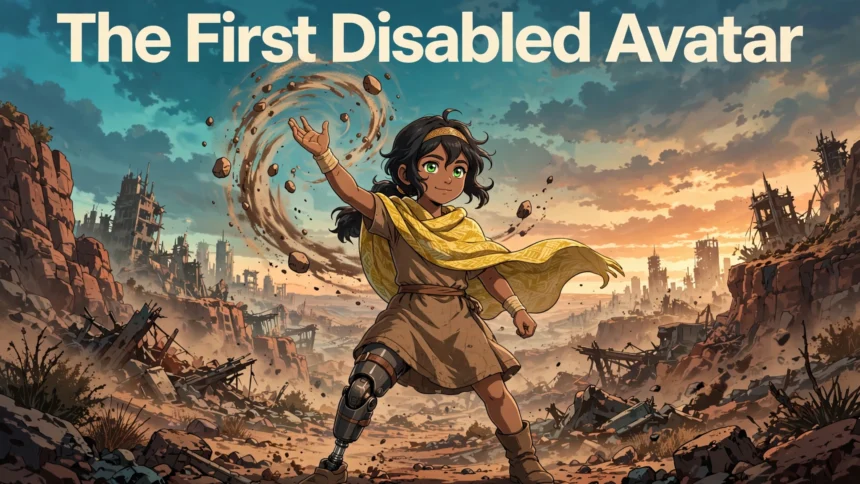
Pavi Is the First Disabled Avatar — and Why That Changes Everything

In twenty years of Avatar storytelling, no protagonist has ever looked like Pavi. Not Aang, the wide-eyed prodigy. Not Korra, the athlete in the spotlight. The new Avatar is a nine-year-old earthbender who is missing a leg — and she is the first disabled Avatar protagonist in the franchise’s history. That’s not a footnote to Avatar: Seven Havens. It’s arguably the most consequential casting decision the franchise has ever made.
I’ve been thinking about disability representation in animation for a long time — this site published a whole piece on writing disability with academic citations back in 2020. What’s happening with Pavi deserves a harder look than a celebratory press release. This is a flagship, not a favor. So let’s be precise about the claim, honest about the nuance, and clear-eyed about what the show still has to prove.
Pavi Is the First Disabled Avatar Protagonist
First, the facts. Pavi, voiced by Saheli Khan, is the protagonist of Avatar: Seven Havens, which premiered October 9, 2026 on Paramount+ and is set roughly 225 years after The Legend of Korra. She is a nine-year-old earthbender living in the city of Ellora, hunting down the truth about her past alongside her long-lost twin, Nisha. And she is an amputee — one leg gone, the disability visible and unhidden from her first frame on screen. If you want the full rundown of who Pavi is, we published a character guide alongside this piece — but the representation story needs its own room.
Now the precision, because this claim has to survive scrutiny. Saying “Pavi is the first disabled Avatar protagonist” invites three immediate objections, so let’s answer all of them.
“What about Toph?” Toph Beifong is disabled — a blind earthbender — but she was never the Avatar or the protagonist. She was the greatest supporting character in animation history, not the chosen one. That distinction is the entire point of this article.
“What about Korra?” Korra lived a disabled arc, not a disabled life. The platinum poisoning at the end of Book 3 left her in a wheelchair, traumatized, and fighting to rebuild herself through Book 4 — one of the most honest depictions of recovery the franchise ever attempted, as our look at Korra’s Book 4 arc has explored. But it was temporary. Korra healed. Her disability was a chapter, not her identity from the start.
“Is an amputee protagonist really that different?” Yes — because the Avatar is the most powerful being alive. Pavi is the first protagonist who is the Avatar and is disabled from the very beginning, with the disability as a permanent part of who she is rather than a wound to be healed or a sidekick’s trait to be worked around. The claim holds. But it only holds if you state it exactly this way — and it matters that we do.
Toph Walked So Pavi Could Fly
To understand why Pavi’s arrival lands the way it does, you have to go back to the blind earthbender who started it. Toph Beifong remains one of the most beloved characters in all of animation, and her treatment is the reason this conversation is possible at all.
Toph’s blindness was never treated as a limitation by the writing. That is the single most important sentence in the franchise’s history of disability representation. The show didn’t make her blindness a tragedy to overcome — it made it the engine of her power. She learned earthbending by listening to the earth through her feet, invented metalbending outright, and spent the series being catastrophically underestimated by everyone who thought a blind little girl couldn’t be the most dangerous bender alive. Her story was never about being cured. It was about being underestimated.
That’s why Toph matters here: she proved the audience could accept — could love — a disabled character whose disability is neither erased nor turned into the whole plot. She built the trust. Twenty years of fans arguing about Toph — in the same fandom that still wages the legendary shipping wars over whether Zutara should have been canon — prove how deeply this character lives in people’s heads. Pavi inherits that trust. She doesn’t have to prove that a disabled character can carry scenes, because Toph already did. She gets to spend that inheritance on something harder: carrying the entire franchise.
What Changes When the Avatar — Not the Supporting Character — Is Disabled
Here’s the structural shift that nobody is talking about enough. Toph was disabled at the margins of the Chosen One’s story. Pavi is disabled at its center. The margins-to-center move changes everything about how disability functions in the narrative.
Power and vulnerability live in one body now. The Avatar is, by definition, the most powerful person in the world — the bridge between spirits and humans, the one soul that reincarnates with the fate of civilization attached. Put that weight inside a nine-year-old amputee and the story can’t do the easy thing anymore. It can’t write disability as a side quest. Every threat she faces, every bending battle, every journey across a ruined world is happening to a body that is simultaneously the strongest and the most vulnerable thing in the frame. That tension is new. It’s also honest in a way fantasy rarely is: most real people who carry enormous responsibility are also carrying something that makes it harder.
The world fears her anyway. This is the detail that makes the representation work narratively, not just symbolically. The series premiere establishes that in the post-cataclysm world, the Avatar isn’t a savior — she is viewed as a destroyer, blamed for the shattered world, and Pavi is hunted and feared from the moment her identity surfaces. Nobody is looking at this child and thinking she’s too fragile to be dangerous; they’re terrified of her. That’s a radical framing for a disabled protagonist. The show doesn’t ask you to pity her. It asks you to fear her, the way the world fears any Avatar — and then it lets her be a scared nine-year-old anyway.
The center holds differently than the margins. When a disabled character supports the hero, their disability is always partly in service to someone else’s arc — the lesson the hero learns, the perspective they gain. When the disabled character is the hero, the story has nowhere to outsource the emotional labor. Pavi’s relationship with her body has to be hers. Her frustration, her competence, her bad days and her triumphs all belong to her own arc, not to Nisha’s or anyone else’s. That is representation at the center rather than the margins, and it is the thing no Avatar story has attempted before.
What the Show Has to Get Right
Early reviews are encouraging — CBR’s review noted that the show’s “disability and LGBTQ+ representation blends exceptionally well with themes of identity and independence” (read the full review). But praise for the first three episodes is a promise, not proof. Here’s what the rest of the season has to deliver for this representation to mean something.
- No inspiration porn. The laziest trap in disability storytelling is the “inspirational” framing — the disabled character exists to make the audience feel uplifted about their own lives. Pavi cannot be the franchise’s lesson in gratitude. She has to be allowed to be angry, selfish, scared, and difficult, the way every Avatar has been allowed to be a whole, flawed person.
- Keep her competent. The fastest way to betray this premise is to have her rescued constantly, or to bend the plot so her disability never actually matters. Toph’s legacy demands the opposite: let the disability shape how she fights, how she moves through the world, how she solves problems — and let her be extraordinary at it, on her own terms.
- Disability as identity, not the entire plot. Pavi’s amputation should be part of who she is, not the mystery she has to solve. The show already has enough plot — twin origins, a ruined world, a hunted Avatar. Her leg doesn’t need to be a metaphor for any of it. Let it simply be true about her, the way her earthbending is.
- Let the Avatar State complicate it. This is the big unanswered question. What happens when a disabled Avatar enters the Avatar State — the most powerful, least human mode in the franchise? Does her body change? Does it matter? The show doesn’t have to answer this in season one, but it can’t pretend the question doesn’t exist.
Why Pavi Matters
Representation arguments often collapse into counting — how many disabled characters, how many minutes of screen time. Pavi resists that because the point was never the count. The point is position. For twenty years, the Avatar franchise put its most powerful role in the hands of able-bodied kids and put its disabled icon in the supporting cast. It did that supporting role better than almost any show in history, and then it stopped.
Pavi is the franchise finally finishing the thought. A disabled child is not the comic relief, not the wise mentor, not the tragedy, not the lesson — she is the Avatar. The bridge between worlds. The one the story cannot happen without. If Seven Havens holds its nerve on the four things above, this won’t just be a milestone for Avatar. It’ll be the new standard for what disability representation in animation is allowed to look like: not at the margins, but at the center, where the most powerful person in the world has a prosthetic leg and nobody in the writers’ room thought that was a contradiction.
That’s why Pavi matters. Not because she’s the first — though she is — but because of where she stands.