

When Avatar: Seven Havens introduced Pavi, she looked like a straightforward milestone: the first disabled Avatar in franchise history, a young Earthbender navigating a broken world on a wooden prosthetic leg. Episode 6, “Night of the Afflicted,” complicated everything we thought we knew — and in doing so, gave children’s animation one of its most honest portrayals of disability ever put on screen.
The episode opens with Pavi in pain — pain in a leg she doesn’t have. What follows rewrites her backstory, deepens the show’s disability representation, and sets up the biggest mystery heading into episodes 7–9. Here’s what the show actually reveals, and why the way it handles Pavi’s disability matters.
AI-generated illustration; unofficial artwork.
How did Pavi lose her leg? What episode 6 actually reveals
Until episode 6, Pavi believed she was born missing the lower part of her left leg. It was the story she’d always told herself — and the one earlier reporting repeated. Then the phantom pain sent her to a doctor, and the doctor’s diagnosis cracked that story open: Pavi is experiencing phantom-limb pain, which means she lost the leg within the last few years. She wasn’t born without it.
The show doesn’t hand us the cause. Instead, it scatters clues. During the twins’ confrontation with the Anomaly, a restored memory shows their parents planning a two-week journey through the Harshlands — and an earlier vision showed four figures crossing that same wasteland, an Anomaly storm, and one of the girls falling. Polygon’s ending explainer connects the threads: the twins’ missing memories, Pavi’s injury, their parents’ disappearance, and Karthik finding Nisha alone all seem to point at a single incident in the Harshlands three years ago. That connection is still unconfirmed — but the timeline fits.
What matters more than the cause is what the revelation does to Pavi. Her disability isn’t a birth trait she’s made peace with. It’s a wound tied to the same lost night as everything else she can’t remember.

AI-generated illustration; unofficial artwork.
Phantom-limb pain: the detail most shows would skip
Phantom-limb pain — real pain felt in a limb that isn’t there — is something most children’s shows would never touch. Seven Havens opens an entire episode with it. Pavi wakes hurting in a leg that doesn’t exist, and the show treats that pain as completely real, not as a metaphor or a mystery to be solved by bending.
It’s a strikingly grounded choice for a fantasy series. The doctor doesn’t offer a spiritual cure or a bending workaround; she offers a diagnosis. And as But Why Tho’s review notes, the episode offers a rare, raw look at a young amputee’s daily reality — the kind of specificity that continues the franchise’s strong record on disability representation.
The wooden prosthetic — and bending on one leg
After the diagnosis, Pavi is fitted with a crutch to use until a proper prosthetic is ready — and she refuses help getting around at every turn. Her independence isn’t inspirational-poster material; it’s stubborn, prickly, and completely recognizable. She’s been on her own for a long time, and accepting help feels like admitting weakness.
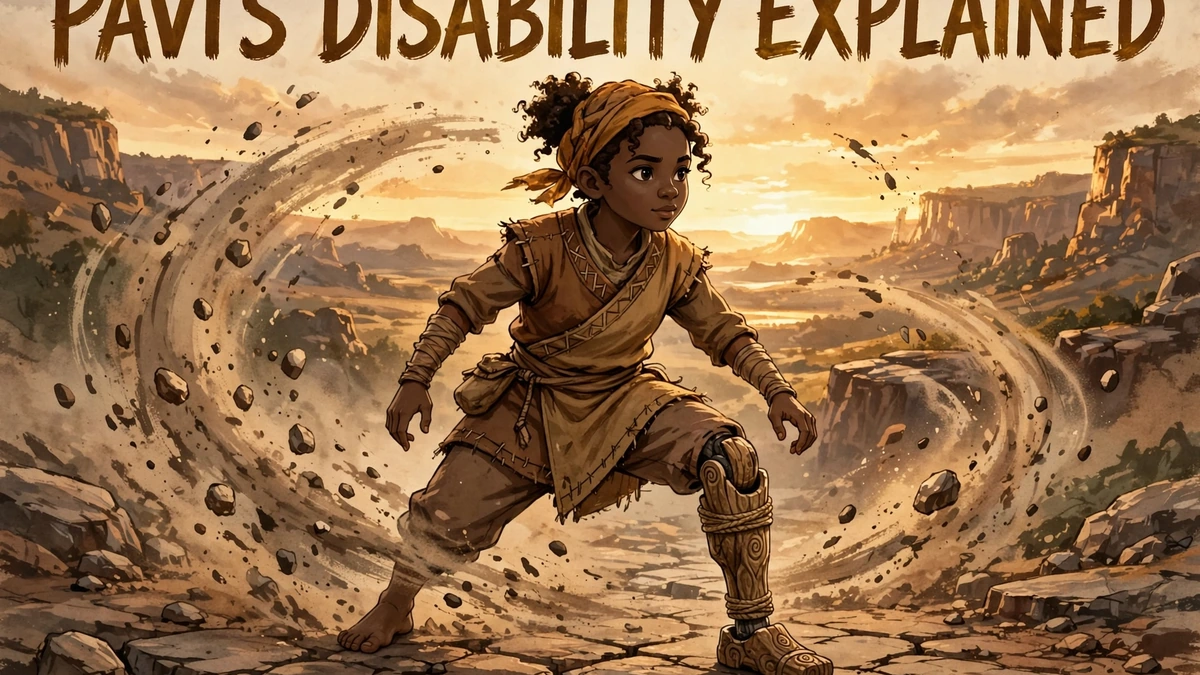
What the show notably does not do is let bending fix any of this. Pavi’s earthbending doesn’t regrow the leg, doesn’t numb the phantom pain, and doesn’t come with a supernatural compensation prize. Her disability exists alongside her power, not underneath it. That’s a harder and more honest choice than most fantasy makes.

AI-generated illustration; unofficial artwork.
“I am not the Avatar. The Avatar has two legs.”
The episode’s most devastating line comes when an Afflicted man confronts Pavi and she tells him: “I am not the Avatar. The Avatar has two legs.” It’s denial, yes — but it’s also internalized ableism spoken out loud. Pavi has absorbed the idea that the Avatar is supposed to look a certain way, and her own body is the evidence she uses against herself.
The irony is sharp: this is a world that already fears the Avatar. Pavi has two reasons to hide — she’s the Avatar, and she’s disabled in a way she’s been taught to see as disqualifying. The show lets her sit in that contradiction instead of resolving it with a speech.
And then, in the hospital fight, something shifts. When the red-black entity attacks, Nisha literally serves as Pavi’s crutch — and Pavi lets her. The girl who refused every hand finally takes one, not as surrender but as strategy. The twins drive the entity back together, using energy bending in tandem. Independence, the episode suggests, doesn’t have to mean doing it alone.
Pavi and Toph: two different kinds of disability representation
Comparisons to Toph Beifong are inevitable — and instructive. Toph’s blindness came paired with seismic sense, a bending-adjacent superpower that effectively offset her disability. It’s beloved representation, but it carries a quiet bargain: the disability is “okay” because it’s compensated. We’ve written about why Toph still sets the standard, and she does — but Pavi represents something different.
Pavi gets no compensation. No spirit-sight, no bending workaround, no trade. Her prosthetic is carved wood, her pain is neurological, and her bending has to work around a body that won’t change. Where Toph’s story says disability can come with its own kind of power, Pavi’s says disability doesn’t need to come with anything at all to deserve centering. Both stories belong in the franchise. Having both is what makes the representation complete.

AI-generated illustration; unofficial artwork.
What the show still hasn’t told us
The biggest questions are still open: what exactly happened in the Harshlands three years ago? Did Pavi lose her leg to the Anomaly, the storm, or something else entirely? Why do neither twin remember it? And what does the truth do to Pavi’s already fragile sense of self when she learns it?
Episodes 7–9 — “What Lies Beneath” and the two-part “The Envoys” — arrive October 23, and the twins’ recovered memories suggest answers are coming. Whatever the show reveals, it has already done something rare: trusted a children’s audience with the unvarnished reality of a young amputee’s life. Meet the full cast of characters here, and brace for the next batch.