

Vender or Vendor and More Spelling Questions Answered
English spelling is full of pairs that look almost identical and mean completely different things — or, just as often, pairs where only one spelling is right at all. Like our companion guide to Silk vs Satin and More Everyday Comparisons, this article gives a plain verdict on each pair, with a memory trick where one helps. The headline answer first: vendor is correct, vender is outdated.
Vender or Vendor: Which Is Correct?
Use vendor. A vendor is a person or business that sells goods or services: a street vendor, a software vendor, a wedding vendor. Vender is an older, historical spelling of the same word, from the same Latin root vendere, meaning “to sell,” via Anglo-French. It survives in old texts and in one famous house style (The New Yorker), but modern dictionaries list vendor as the standard spelling in both American and British English, and vender reads as a mistake in ordinary writing. The confusion is understandable — seller, buyer and supplier all end in -er — but vendor belongs to the Latin-derived -or family, like actor and editor. A clear explanation of the history is at One Minute English’s vendor or vender guide, and TextRanch’s vendor or vender check gives the same verdict.
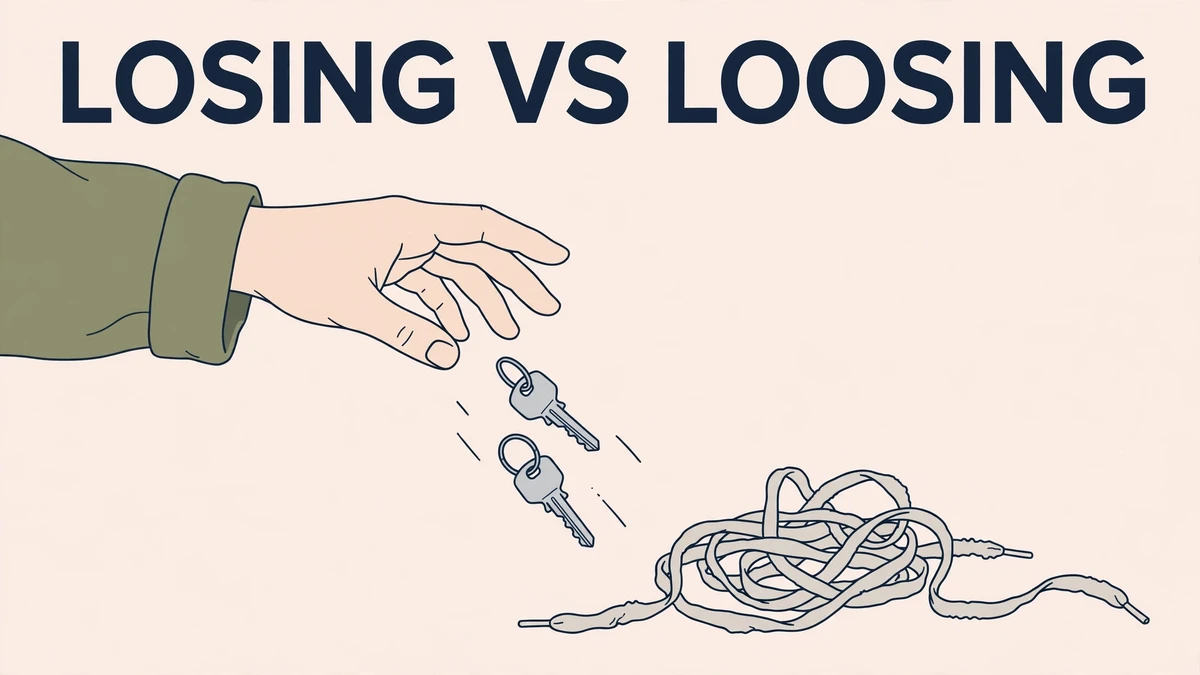
Losing vs Loosing: One Letter, Two Verbs
Losing means misplacing something or failing to win: losing your keys, losing a game. It comes from lose, with one o. Loosing means releasing or untying: loosing an arrow, loosing a knot. It comes from loose, with two o’s. If you can replace the word with “misplacing” or “not winning,” you want losing. If you mean “letting go,” you want loosing.
Manner vs Manor: Behaviour or a Big House?
Manner is a way of doing something, or a person’s behaviour: “in a friendly manner,” “good manners.” Manor is a large country house or estate, historically the house of a lord of the manor. Memory trick: a manor is a place you could live in; a manner is how you live. The two words are pronounced almost identically, which is why they get swapped.

Oversite vs Oversight: Only One Is Standard
Use oversight. Oversight has two related meanings: supervision (“under her oversight”) and a mistake or something missed (“an oversight in the accounts”). Oversite is not the standard spelling in modern English — if you see it, it is almost certainly a misspelling of oversight. The same pattern applies to several pairs below: when in doubt, trust the dictionary headword, not the version that “looks right” because of a familiar pattern.
How Do You Spell Mama, Aging and Shiny?
Mama is spelled M-A-M-A. A variant, mamma, exists, especially in British English, but mama is the standard, everyday spelling. Aging is the American spelling, A-G-I-N-G; British English usually writes ageing, keeping the e. Both are correct — pick the one that matches your audience and stay consistent. Shiny is spelled S-H-I-N-Y, and its comparative forms change the y to i: shinier, shiniest.
Skillset or Skill Set? In Tact or Intact?
Skill set is two words in standard professional writing: “a skill set in design and writing.” The one-word form skillset does appear, especially online and in some dictionaries, but two words is the safer choice for a CV, proposal or formal email. Intact is one word, always: “the package arrived intact.” The two-word form “in tact” is incorrect — tact on its own means sensitivity in dealing with people, which is a different word entirely.
Waver or Waiver: Hesitating or Giving Something Up?
Waver is a verb meaning to hesitate, tremble or be unsteady: “she never wavered in her support.” Waiver is a noun (sometimes also a verb) meaning a document or agreement that gives up a right or claim: “sign a waiver before the activity.” Memory trick: you sign a wai-ver, with an i like “I give this up”; you wa-ver when you are unsteady. Mixing them up changes a hesitation into a legal document, so this one is worth getting right.

Input or Imput? Councilor or Counselor? Naive or Nieve?
Input is correct; imput is a misspelling. The word ends in -put, like output and throughput. Councilor (US spelling; councillor in the UK) is a member of a council. Counselor (US spelling; counsellor in the UK) is a person who gives advice or guidance, such as a school counselor or a legal counselor. The two jobs sound alike but are spelled differently — council for the body, counsel for the advice. Naive is correct, N-A-I-V-E (the form naïve, with a diaeresis over the i, is also acceptable); nieve is not the English spelling.
IMK Mean, Sent as SMS, SMH Means and EVB Means: Texting, Decoded
IMK is disputed texting shorthand: it is read as “in my knowledge” (as far as I know), as “I’m kidding” (a joke marker), and as “I mean, you know” — the meaning depends on context, so do not rely on a single expansion. For example, “IMK, the shop opens at nine” uses the “in my knowledge” reading. It is far less established than IMO or IMHO, so in formal writing, write the words out. Sent as SMS is the message your phone shows (on iPhones, usually with a green bubble) when a message goes out as an ordinary SMS text instead of an internet message: typically because the recipient is not on the same messaging service, or data or the service is unavailable. It does not mean the message failed — it means it travelled by the older SMS route. SMH means “shaking my head,” used for disbelief or disappointment. EVB is less settled: it is often read as “everybody” in texting and social posts, but it is ambiguous and not a standard abbreviation, so spell out “everybody” if you want to be understood. The same caution applies to the slang in our guides to WTD, IDM and more texting meanings, WYFF and tweaking and DTM, STSU and JSP: if an abbreviation is ambiguous, the full words are always the safer choice.
Quick Answers, All in One Place
Vendor, not vender. Losing keys, loosing knots. Manner is behaviour, manor is a house. Oversight, not oversite. Mama, aging (US) or ageing (UK), shiny. Skill set in two words, intact in one. Waver to hesitate, waiver to sign away. Input, councilor for a council member, counselor for an adviser, naive. IMK is disputed (“in my knowledge”, “I’m kidding”, or “I mean, you know”), sent as SMS means the SMS route, SMH is “shaking my head,” and EVB is best written out as “everybody.” Good spelling is rarely about memorising every rule — it is about knowing which pairs actually have two meanings and which have only one correct form — a habit that serves any writer, including the authors in our Black women writers guide.