
HBCU Fantasy Books: Magical Reads Set at Black Colleges
AI-generated illustration; unofficial artwork
If you have ever typed “fantasy books set at a magical HBCU” into a search bar, you know the frustration: the results are full of books that are not actually set at an HBCU at all. The good news is that the real thing exists now — a small but growing shelf of fantasy built around historically Black colleges, where the campus itself, with its homecoming, Greek life, and conjure traditions, is part of the magic. Start with our Black fantasy books guide for the wider landscape, then come back here for the HBCU shelf specifically.
Are there fantasy books set at magical HBCUs?
Yes — but until recently, almost none. For years, the closest most readers got was a Black protagonist at a predominantly white magical school. That is a different story, and a good one, but it is not an HBCU story. The books below are the real entries: fantasies where the school is a Black institution, or explicitly imagined as one. We have marked one famous near-miss separately, because it tops nearly every search list and deserves an honest label.
1. Blood at the Root by LaDarrion Williams (2024)
This is the book to start with, and the one that defines the subgenre. Malik is 17, on the run from his past, and hiding powers he cannot control after his mother mysteriously vanished ten years earlier. A daring rescue reveals a connection to his long-lost grandmother, a legendary conjurer with ties to a hidden magical university his mother attended. That university is Caiman University — an HBCU for the young, Black, and magical, in the words of its publisher.
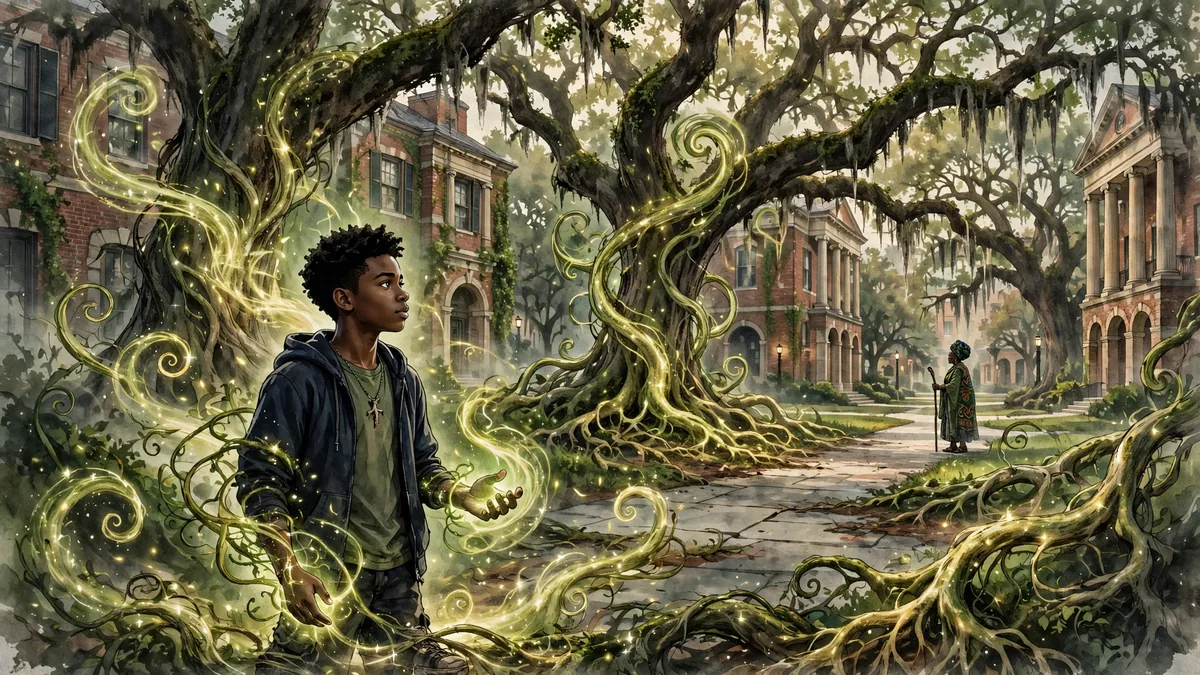
AI-generated illustration; unofficial artwork
At Caiman, Malik finds feuding covens, magical politics, forbidden knowledge, and an evil dating back to the Haitian Revolution. The sequel, Bones at the Crossroads (July 2025), picks up in fall semester at Caiman, with Malik navigating a secret society his mother once belonged to. A third book, Ashes at the Altar, completes the trilogy. Published May 7, 2024, Blood at the Root became a New York Times and USA Today bestseller — proof that readers were waiting for exactly this book. Read it first if you want the full HBCU magic-school experience: classes, homecoming, fraternities and sororities, and all.
2. Sorcerority by Mikhail Sebastian and George T. Watson
Sorcerority is a graphic novel set at Excursia, described as the world’s first and last HBCU of Magic. Its heroine, Maggie, arrives at the school only to realize her enrollment may be part of a greater plan. The pitch — Black girl magic plus sisterhood, in comics form — is the whole appeal, and it landed: Gabrielle Union and Taraji P. Henson signed on to produce a film adaptation. If you like your HBCU fantasy visual, start here; the graphic novel is also available to read free online at the book’s own website.

AI-generated illustration; unofficial artwork
3. The Secret World of Maggie Grey by Drew Collins
Another Maggie, another magical HBCU — do not confuse the two. Collins’s novel follows Maggie Grey and her friend Asha through a multi-perspective story that pairs everyday college life (parties, classes, friendships) with a secret magical world running alongside it. The HBCU campus setting is the point: the magic is layered over real Black college culture rather than dropped into a generic castle. Readers who like a slower build should know the first half leans more college drama than fantasy, before the magical plot takes over in the second half.
4. I’ll Make a Spectacle of You by Beatrice Winifred Iker
For readers who want their HBCU fantasy darker, this horror-leaning novel is set at Bricksbury University, a Tennessee HBCU. Zora Robinson is a graduate student in Appalachian Studies researching religions, folklore, and hoodoo — and a beast that supposedly lurks in the university woods at night. A century-old diary connects the beast to students who disappeared before, and students are going missing again now. It blends African Baptist faith, hoodoo and conjure, and Appalachian folklore into a dark-academia mystery, and it is the best pick on this list if you came here from our spooky-season shelf rather than the magic-school shelf.
Is Legendborn an HBCU book? No — and that matters
Tracy Deonn’s Legendborn (2020) tops almost every “HBCU fantasy” search list, so let us be plain: it is not set at an HBCU. Sixteen-year-old Bree Matthews attends a residential program at UNC–Chapel Hill, where she infiltrates a secret society of Legendborn students — descendants of King Arthur and his knights. The society is historically white, and Bree’s position as the Black girl inside it, fighting to be recognized, is the engine of the book. It won the Coretta Scott King–John Steptoe Award for New Talent, and its sequels Bloodmarked (2022) and Oathbound (2025) widen the story into a full magical war.
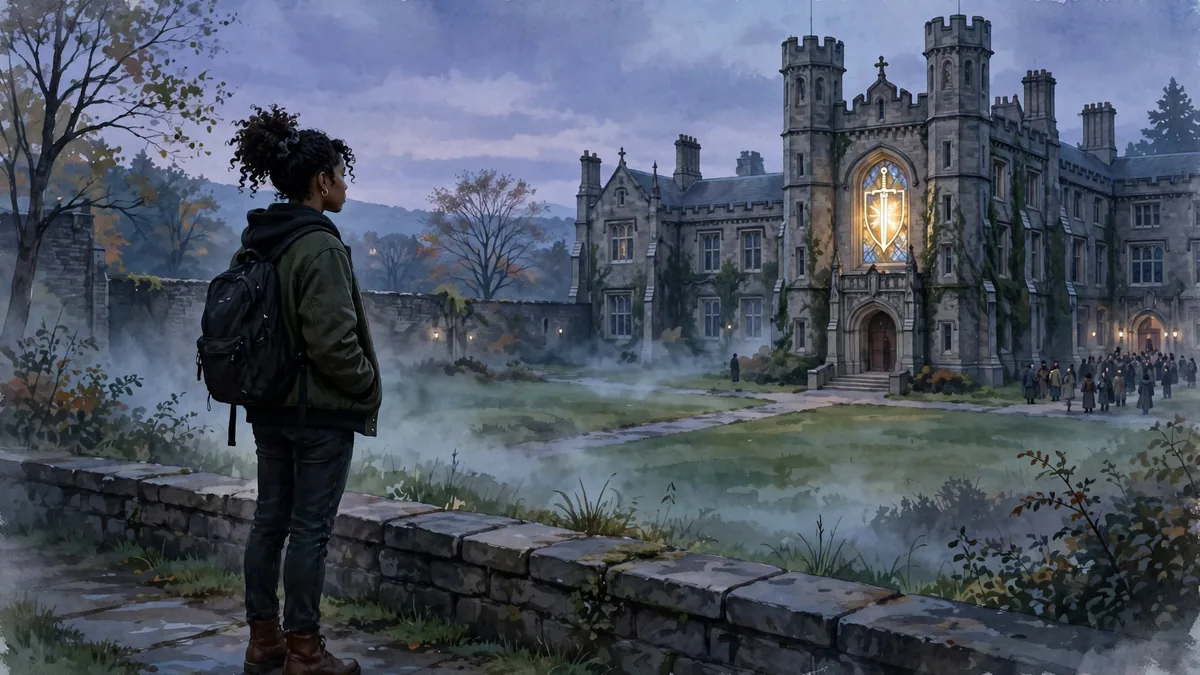
AI-generated illustration; unofficial artwork
Read Legendborn for the feeling of being the only one in a legacy institution — just do not shelve it as an HBCU book. The distinction is the whole reason this list exists: HBCU fantasy is not “Black girl at a magic school.” It is Black girl at a Black school, where she does not have to explain herself to belong.
Where to go next
If the campus setting hooked you, Blood at the Root has two sequels waiting, and our books like Children of Blood and Bone list covers more West African-inspired epic fantasy. For the authors behind the movement, our Black women writers guide is the map, and if you want the theory behind why these stories land, our Afrofuturism books for beginners guide explains the tradition these books are building on. The HBCU fantasy shelf is still short — which is exactly why it is exciting. These four books are not filling a gap. They are opening a door.
Sources: Penguin Random House Library, Blood at the Root; Kirkus Reviews, Sorcerority film adaptation.